Primary Source
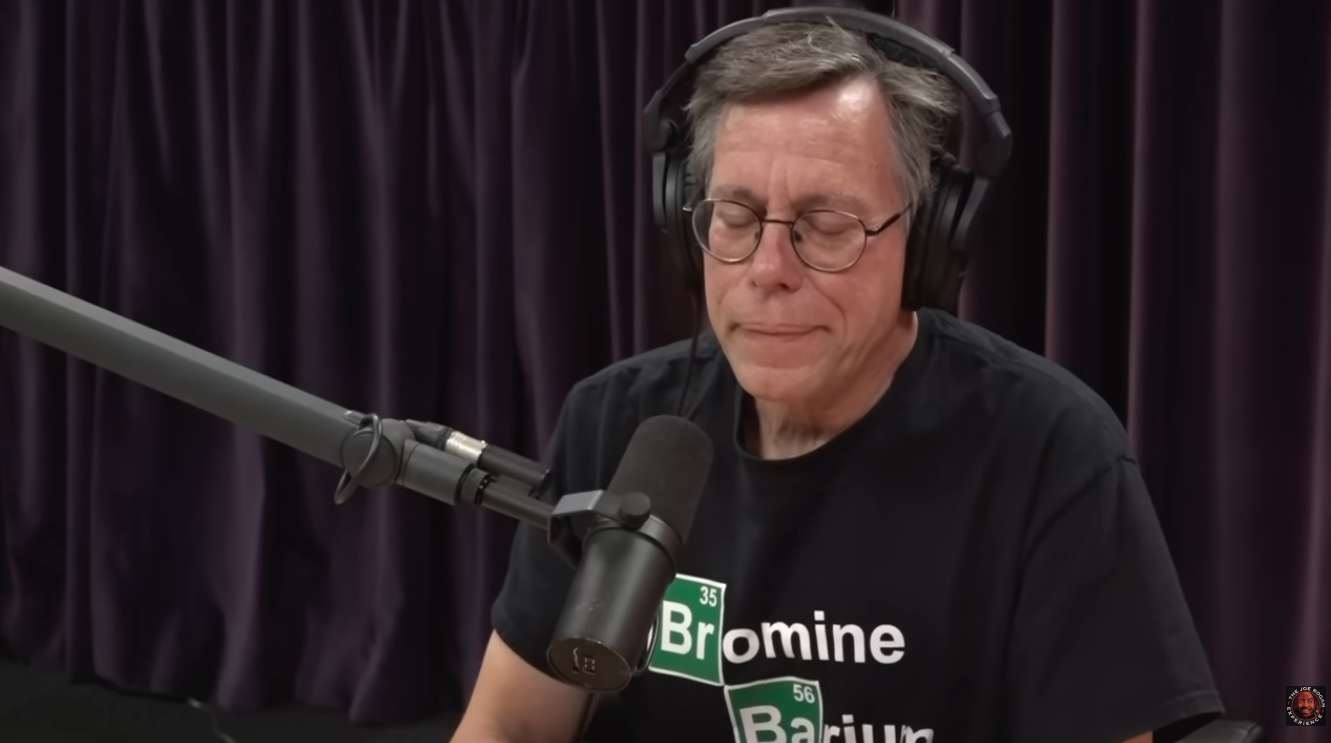
Joe Rogan Experience #1315 — Bob Lazar & Jeremy Corbell
Primary guest: Bob Lazar · Additional guest: Jeremy Corbell · Host: Joe Rogan · YouTube @PowerfulJREIntroduction
Introduction: The Story That Changed Area 51 Forever
In 1989, a previously unknown man named Bob Lazar appeared in a television interview with investigative journalist George Knapp and made an extraordinary claim.
Lazar said he had worked at a classified installation called S-4, located near Area 51 in Nevada, where the United States government possessed several disc-shaped craft of non-human origin. According to his account, his assignment was to help determine how one of those vehicles generated power and manipulated gravity.
The story helped transform Area 51 from an obscure military testing site into one of the most recognizable symbols of UFO secrecy in popular culture.
Thirty years later, Lazar appeared on The Joe Rogan Experience alongside filmmaker Jeremy Corbell to recount the story in detail. During the interview, Lazar described the alleged spacecraft, its compact interior, its gravity-based propulsion system, a fuel source involving element 115, and the security apparatus surrounding the project.
He also addressed the controversies that have followed him for decades, including missing educational records, questions about his scientific credentials, inconsistencies in his biography, and the absence of physical evidence that could conclusively prove his claims.
Lazar’s account remains one of the most influential and disputed stories in modern UFO history. Some details appear consistent with information that became publicly known later. Other parts depend almost entirely on Lazar’s testimony and have never been independently verified.
This article examines what Lazar claimed, why some investigators find his story compelling, and why significant questions remain unanswered.
Investigation Note
Who Is Bob Lazar?
Robert “Bob” Lazar is an American businessman and self-described scientist who became publicly known after claiming that he had worked on an effort to reverse-engineer alien spacecraft near Area 51.
Lazar says he worked briefly at Los Alamos National Laboratory before being recruited into a highly classified program operated at S-4, an alleged installation near Papoose Lake in Nevada.
According to Lazar, his work involved the power and propulsion system of one of nine disc-shaped craft stored at the facility.
He first told his story publicly through George Knapp, initially appearing in silhouette under the pseudonym “Dennis.” Lazar later revealed his identity and provided additional interviews describing the project.
The Rogan episode features three central voices:
- Bob Lazar, recounting the alleged events
- Joe Rogan, questioning the story and its evidence
- Jeremy Corbell, defending Lazar’s credibility and discussing his documentary investigation Lazar appears uncomfortable throughout portions of the interview and experiences a migraine that temporarily affects his ability to recall details. Rogan acknowledges the difficulty but continues pressing him on areas where the story is unclear or disputed.
Investigation Note
From Los Alamos to a Classified Job in Nevada
Lazar says his path to S-4 began while he was living in New Mexico and working at Los Alamos.
He had developed a reputation as someone interested in unconventional technology and had installed a jet engine in a Honda automobile. An article about the vehicle described him as a physicist working at Los Alamos.
Lazar says he later contacted physicist Edward Teller, sometimes called the father of the hydrogen bomb, after attending one of Teller’s lectures. According to Lazar, the brief interaction eventually helped him secure an interview for a classified position in Nevada.
He claims he was flown to the region, processed through security, and transported from Area 51 to a more restricted facility at Papoose Lake.
The job initially appeared to involve advanced propulsion research. Lazar says he did not understand the true nature of the assignment until he was shown briefing materials and eventually saw one of the craft.
What Is Supported Within Lazar’s Account
Lazar was reportedly listed in an old Los Alamos telephone directory, and a newspaper article described him as a physicist working at the laboratory.
George Knapp has also said that Lazar was able to navigate the Los Alamos facility and was recognized by people there during a visit.
What Remains Disputed
These details suggest that Lazar had some connection to Los Alamos, but they do not establish:
- His precise job title
- Whether he was employed directly by the laboratory or by a contractor
- His level of scientific responsibility
- Whether he held the educational qualifications he later claimed
- Whether his Los Alamos work led to employment at S-4 A connection to Los Alamos supports part of Lazar’s biography, but it does not independently prove the spacecraft story.
Investigation Note
What Was S-4?
Lazar describes S-4 as a highly restricted facility approximately fifteen miles south of Area 51, near Papoose Lake.
According to him, the installation was built into the base of a mountain. Hangar doors were covered in material intended to blend visually with the surrounding terrain, making the facility difficult to see from the air.
Lazar says personnel were transported there in a bus with covered windows and subjected to strict compartmentalization. Employees worked only on limited portions of the project and were not given a complete understanding of the operation.
He claims the facility contained nine disc-shaped craft of different designs.
Lazar says he was assigned to one craft that appeared intact and functional. He gave it the nickname “the Sport Model” because its shape reminded him of a sleek commercial version of a flying saucer.
Lazar’s Claim
S-4 was a concealed installation devoted to studying and attempting to reproduce the technology of non-human spacecraft.
Confirmed Context
Area 51 and the surrounding Nevada Test and Training Range have been used for highly classified aircraft and weapons development.
Unverified
No publicly authenticated records have conclusively demonstrated that the S-4 facility described by Lazar exists or housed extraterrestrial vehicles.
Investigation Note
The First Time Lazar Says He Saw the Craft
Lazar recalls initially seeing a disc-shaped object inside a hangar.
His first assumption was that it was a secret aircraft built by the United States. He noticed what appeared to be an American flag on its side and interpreted it as an experimental human vehicle.
According to Lazar, the flag may have been placed there for identification, perhaps to indicate which team was studying the craft.
His understanding changed after reading briefing documents that described the object as a recovered vehicle and discussed its alleged origin.
Lazar says the craft did not resemble ordinary human engineering.
It had no visible rivets, seams, wiring, bolts, control panels, fuel tanks, or conventional engine components. Interior surfaces appeared smoothly fused together, as though the entire vehicle had been formed from one continuous piece of material.
He compares its appearance to an object modeled from wax and then partially melted so that every edge became curved.
The lack of recognizable manufacturing features is central to his argument that the craft was not human-made.
However, without photographs, material samples, or access to the vehicle, the description remains personal testimony.
Investigation Note
A Craft Built for Small Occupants
Lazar says the interior was too small for an average adult human to move through comfortably.
At approximately five feet ten inches tall, he could not stand upright except near the center of the craft. He describes the seats and passages as being designed for occupants roughly half his height.
There were three seats positioned around the central reactor.
The interior allegedly contained:
- Three small seats
- A central power source
- Three gravity amplifiers
- Supporting components
- Upper and lower levels
- No conventional controls
- No visible screens, buttons, switches, or wiring Lazar interpreted the dimensions as evidence that the craft had been designed for beings around three or four feet tall.
He does not claim that he personally saw an extraterrestrial occupant while working at the facility.
Important Distinction
An interior designed for small occupants would be suggestive if the craft’s existence were independently confirmed. Because the vehicle itself remains unavailable for examination, the claim cannot presently be tested.
Investigation Note
The Briefing Documents and Zeta Reticuli
Before working directly with the alleged propulsion system, Lazar says he was given short briefing documents about the overall project.
The program was heavily compartmentalized, so the documents provided only limited information about areas that might overlap with his assignment.
According to Lazar, the briefings discussed:
- The craft’s power and propulsion system
- Its possible origin
- Material science
- Potential weapon applications
- Human physiological effects
- Other related research projects One document allegedly stated that the craft originated from “ZR3,” which Lazar interpreted as the third planet in the Zeta Reticuli star system.
Zeta Reticuli is a real binary-star system located roughly forty light-years from Earth. It had already entered UFO mythology through the Betty and Barney Hill abduction story.
Lazar is careful during the Rogan interview not to claim that he independently confirmed the craft’s origin.
He says only that the information appeared in the briefing material.
He also acknowledges that some details may have been deliberately inserted as disinformation. Compartmentalized programs sometimes provide different versions of sensitive information to identify the source of a leak.
Confirmed
Zeta Reticuli is a real star system.
Lazar’s Testimony
A classified briefing identified ZR3 as the craft’s place of origin.
Unverified
There is no publicly available evidence demonstrating that the vehicle existed, came from Zeta Reticuli, or that a habitable third planet was known there at the time.
Investigation Note
Element 115: The Alleged Fuel Source
Perhaps the most famous part of Lazar’s story concerns element 115.
He says the craft’s reactor used a stable form of an extremely heavy element with an atomic number of 115. At the time Lazar first discussed it publicly, element 115 had not yet been officially synthesized and recognized.
Scientists later created element 115 in laboratories. It is now known as moscovium.
Supporters of Lazar frequently point to this development as evidence that his story was ahead of its time.
The distinction, however, is more complicated.
Scientists had long understood that undiscovered elements should exist at higher atomic numbers. The periodic table already indicated where element 115 would be positioned, even before it was successfully synthesized.
The laboratory-created isotopes of moscovium are also highly unstable and decay very quickly.
Lazar claims the government possessed a different, stable isotope that did not naturally exist on Earth in meaningful quantities.
What Lazar Says the Element Did
According to Lazar, element 115 served two purposes:
1. It produced antimatter when bombarded with protons. 2. Its nucleus generated or amplified a gravitational effect that could be used for propulsion. He describes the fuel as a triangular piece placed inside the reactor.
The reactor allegedly required no wiring or ordinary electrical connections. Once the element was inserted, the system activated automatically.
Confirmed
- Element 115 exists and has been synthesized.
- It was theoretically expected before its laboratory creation.
- Known isotopes are extremely unstable.
Lazar’s Claim
The government possessed a stable isotope of element 115 capable of powering a gravity-manipulation reactor.
Unverified
No stable sample matching Lazar’s description has been publicly produced or independently tested.
Investigation Note
Did Lazar Take Element 115 From the Facility?
Lazar has long been associated with claims that he removed a small quantity of element 115 from S-4.
During discussions surrounding his story, it has been suggested that possessing the material provided him with leverage or protection.
If a stable isotope of element 115 were produced and independently verified, it could represent the strongest evidence supporting Lazar’s account.
However, no such sample has been publicly analyzed under controlled conditions.
Lazar has given varying levels of detail about the alleged material and has not made it available for transparent scientific testing.
This creates one of the story’s most important unresolved questions.
If the sample exists, why has it not been submitted to multiple independent laboratories with a documented chain of custody?
Possible concerns could include legal consequences, personal safety, loss of the material, or distrust of institutions. Yet without testing, the alleged sample cannot function as evidence.
Investigation Note
How the Reactor Allegedly Worked
Lazar says his assignment focused on the craft’s power source and propulsion system.
The reactor was approximately the size of a basketball and sat at the center of the lower level. He describes it as extraordinarily powerful despite its small size.
The system allegedly produced no detectable heat, magnetic field, exhaust, or ordinary radiation.
Lazar says his team attempted to measure the reactor through equipment available at the time, including infrared imaging, but could not detect the waste heat expected from a conventional power-generating device.
This seemed to violate ordinary expectations of thermodynamics. Machines that produce useful power normally release at least some energy as heat.
Lazar does not claim that he completely understood the mechanism.
He says his team could observe what the device did and manipulate some of its output, but they could not determine exactly how it operated.
Lazar’s Description
- Element 115 was placed inside the reactor.
- A proton source triggered a reaction.
- The reaction produced antimatter.
- Matter-antimatter annihilation generated energy.
- The reactor converted that energy into a gravity-related field.
- The output was directed through three amplifiers beneath the craft.
Scientific Challenges
This explanation raises major unresolved issues:
- Containing antimatter safely
- Converting annihilation energy efficiently
- Preventing enormous radiation and heat release
- Producing a controllable gravitational field
- Explaining why no conventional support systems were visible
- Demonstrating that gravity can be generated in the manner described No publicly available experiment has reproduced the reactor’s claimed effects.
Investigation Note
Gravity A and Gravity B
Lazar describes two different forms or applications of gravity within the propulsion system.
He calls them “Gravity A” and “Gravity B.”
Gravity A was allegedly a strong nuclear force associated with the stable element 115. The reactor accessed or amplified this force.
Gravity B was described as the more familiar gravitational effect operating over larger distances.
In Lazar’s model, the craft did not propel itself by pushing air or ejecting material. Instead, it generated a distortion in space toward a destination and then allowed the craft to fall into that distortion.
This would resemble moving the environment around the craft rather than accelerating the craft conventionally through it.
The three gravity amplifiers could be directed independently.
For low-speed movement near a planet, Lazar says the craft operated in an “omnicron configuration,” using one amplifier downward.
For high-speed travel, it rotated and pointed all three amplifiers toward the destination in what he called the “delta configuration.”
Potential Connection to Reported UFO Behavior
Lazar argues that this system could explain why UFOs reportedly:
- Hover silently
- Accelerate instantly
- Turn without banking
- Travel without visible exhaust
- Move in ways that would injure occupants in an ordinary craft
- Rotate onto their side before accelerating
Status of the Claim
The description provides a coherent internal model, but no public demonstration has confirmed that the proposed physics or engineering is valid.
Investigation Note
Why Extreme Acceleration Might Not Harm the Occupants
Conventional aircraft place physical stress on passengers when they accelerate or change direction.
Reported UFOs sometimes appear to move so violently that ordinary occupants would experience fatal forces.
Lazar says the craft avoids this problem because the occupants, reactor, and vehicle exist inside the same manipulated gravitational field.
Rather than the vehicle accelerating through space while the occupants lag behind, the entire local region moves together.
From inside the craft, the occupants would not experience acceleration in the conventional sense.
This concept resembles some speculative spacetime models in theoretical physics. It remains far beyond demonstrated engineering.
The proposal may explain a reported observation, but explanatory power alone does not establish that the mechanism exists.
Investigation Note
The Alleged Test Flights
Lazar says the S-4 team conducted scheduled flight tests of the craft.
Most tests involved low-altitude hovering and basic maneuvers rather than high-speed travel. He says the vehicle rose silently and produced a glow or corona around its lower surface.
Because Lazar knew when the tests would occur, he brought friends to a location outside the restricted area on several Wednesday nights.
The group reportedly saw a bright object rising and maneuvering above the desert near the time and place Lazar predicted.
Those witnesses included people who were not employed by the alleged program.
Jeremy Corbell argues that this is one of the strongest parts of the story. Lazar apparently knew when unusual activity would occur in an area that was not widely known to the public.
The group also recorded video, although the footage is distant, dark, and too indistinct to identify the object conclusively.
What the Witnesses May Support
- Lazar knew that an unusual aerial event would occur.
- Multiple people observed a light near the predicted location and time.
- The activity may have been connected to classified testing.
What the Sighting Does Not Prove
- That the object was extraterrestrial
- That it used the propulsion system Lazar described
- That it originated from S-4
- That Lazar personally worked on it
- That the vehicle was not a secret human aircraft or another test system The prediction is intriguing, but the nature of the observed object remains unresolved.
Investigation Note
The Arrest Near the Test Site
During one excursion, Lazar and his companions were discovered near the restricted area by local authorities.
This event supports the claim that the group was physically present near the test range while watching activity.
It also may explain how Lazar’s alleged employers discovered that he had disclosed testing schedules and brought unauthorized witnesses into the area.
Lazar says his security access was already unstable because officials had discovered personal problems involving his marriage. After the test-site incident, his relationship with the program ended.
He describes being threatened, interrogated, and warned about the consequences of revealing classified information.
Lazar says he decided to go public because he feared that remaining silent made him easier to eliminate. Public exposure, he believed, would provide a form of protection.
That reasoning led him to George Knapp.
Investigation Note
Why Lazar Came Forward
Lazar portrays his public disclosure as an act of self-preservation rather than a desire for fame.
He says he initially told only a few people close to him. After security personnel learned of the disclosure, he became afraid that he could disappear or suffer an unexplained accident.
George Knapp and others advised him that becoming publicly known might make retaliation more difficult.
Lazar later came to regret aspects of the decision.
He describes decades of unwanted attention, strangers arriving at his home, damage to relationships, public ridicule, government scrutiny, and constant demands that he retell the story.
Rogan notes that participating in another major interview could increase that attention.
Corbell argues that allowing Lazar to present the complete story may instead help people understand him as a person rather than as a UFO caricature.
Personal Consequences Do Not Prove the Claim
Lazar’s apparent discomfort and reluctance may affect how audiences judge his sincerity, but emotional behavior is not reliable proof of factual accuracy.
A person may be sincere and mistaken. A person may also be deceptive while appearing uncomfortable.
The story must ultimately be evaluated through evidence rather than demeanor alone.
Investigation Note
The Security System and the Hand Scanner
Lazar described an unusual device used to identify workers at the facility.
The machine measured the bones in a person’s hand or fingers using light. Employees placed their hands into a metal guide with pins while the scanner analyzed skeletal proportions.
When Lazar first discussed the device publicly, many people reportedly considered it fictional.
Years later, photographs emerged of a similar hand-geometry scanner known as the Identimat 2000, which had been used at secure facilities.
Supporters view this as another detail that strengthened Lazar’s credibility.
Why the Detail Matters
It demonstrates that Lazar accurately described a security technology unfamiliar to much of the public at the time.
Why It Is Not Conclusive
The device existed in other classified or secure environments. Knowledge of it could indicate that Lazar had entered a restricted facility without proving he worked on alien technology.
It supports his familiarity with certain security procedures, not the full story.
Investigation Note
His Los Alamos Employment Records
Critics have argued that Los Alamos could not confirm Lazar’s claimed employment.
Lazar and his supporters maintain that his records were deliberately removed.
George Knapp later found Lazar’s name in a Los Alamos telephone directory. A newspaper article also referred to him as a physicist working there.
During the Rogan interview, Corbell presents this as evidence that attempts were made to erase Lazar’s history.
A less dramatic possibility is that Lazar worked for a contractor rather than directly for the laboratory, which could explain why central personnel records were incomplete.
Reasonable Conclusion
There is evidence that Lazar had some form of working relationship with Los Alamos.
Unresolved
The available material does not conclusively establish:
- His exact position
- His employer of record
- His academic qualifications
- The level of scientific work he performed
- Whether records were intentionally erased
Investigation Note
The Education Controversy
Lazar has claimed that he studied physics at the Massachusetts Institute of Technology and electronics at the California Institute of Technology.
Investigators have been unable to verify that he attended either institution.
No authenticated diplomas, transcripts, enrollment records, photographs, classmates, professors, or other documentation have conclusively supported the claims.
When questioned, Lazar has struggled to provide details that would normally be expected from someone who attended these schools.
This is one of the most serious challenges to his credibility.
Lazar says his educational history was erased as part of an attempt to discredit him. Critics argue that removing every independent trace of attendance would be extraordinarily difficult, particularly memories held by classmates and faculty.
Possible Interpretations
1. Lazar attended the institutions and records were systematically removed. 2. He attended under circumstances not reflected in ordinary records. 3. He exaggerated or fabricated his education. 4. Parts of his biography became confused over time. 5. His credentials were misrepresented during employment. The episode does not resolve the controversy.
Even if Lazar lied about his education, that would not logically prove that every other claim is false. It would, however, damage his reliability as the primary witness to an extraordinary story.
Investigation Note
Could Someone Without the Claimed Degrees Still Have Been Hired?
Corbell argues that Lazar’s practical technical abilities may have mattered more than formal credentials.
Lazar operated a scientific-supply business, worked with explosives and radiation-detection equipment, built unusual vehicles, and displayed a strong interest in engineering.
Highly compartmentalized projects may recruit people for specific skills, creativity, or unconventional thinking.
However, reverse-engineering a revolutionary propulsion system would ordinarily require advanced knowledge in physics, materials science, nuclear engineering, and mathematics.
The absence of verifiable educational credentials remains difficult to reconcile with the importance of the assignment Lazar describes.
It is possible that he was given a limited technical role and later interpreted it more broadly. It is also possible that his scientific background has been underestimated.
Neither explanation has been proven.
Investigation Note
Nine Craft With Different Designs
Lazar says S-4 contained nine vehicles, each with a different shape or design.
He only worked directly with one craft.
The differences reminded him of the variety seen among human automobiles or aircraft. Separate models could perform different roles while sharing similar power and propulsion systems.
He describes the Sport Model as a smooth disc with a rounded upper section.
Other craft allegedly had different proportions and external configurations.
Lazar does not know:
- Whether all nine came from the same civilization
- Whether they were recovered from crashes
- Whether some were found through archaeological excavation
- Whether they arrived during different periods
- Whether any were built by humans using recovered technology The briefing documents provided only limited information, and he acknowledges that some of it could have been false.
Investigation Note
Project Galileo, Project Sidekick, and Project Looking Glass
Lazar recalls several names associated with projects described in the briefings.
Project Galileo
This was allegedly the effort involving the craft’s propulsion and power system—the area to which Lazar says he was assigned.
Project Sidekick
Lazar says this concerned potential weapon applications of the technology.
He provides little detail and emphasizes that he did not personally work on it.
Project Looking Glass
This project allegedly examined the effects of gravity manipulation on time.
Lazar does not describe a science-fiction machine capable of freely traveling through history. Instead, he suggests the program investigated smaller distortions of time caused by intense gravitational fields.
Because gravity affects spacetime, the general concept has a basis in established physics.
The alleged classified project and its applications remain unverified.
Important Limitation
Lazar says he only saw brief references to these projects. He could not independently confirm what they accomplished or whether every detail in the documents was accurate.
Investigation Note
Element 115 and the “Island of Stability”
Nuclear physicists have theorized that some superheavy elements may possess isotopes that survive longer than nearby unstable nuclei. This proposed region is commonly called the island of stability.
Lazar’s supporters argue that a stable isotope of element 115 could exist within such a region.
The scientific hypothesis does not prove that the isotope Lazar described exists or has gravity-manipulating properties.
A longer-lived superheavy isotope might remain stable for seconds, minutes, days, or longer, depending on its nuclear structure. “Stable” in nuclear physics does not necessarily mean permanently stable.
Even if a long-lived form of element 115 were discovered, additional evidence would be necessary to demonstrate that it could:
- Generate antimatter in the described way
- Amplify gravity
- Power a spacecraft
- Create a controllable spacetime distortion Lazar’s prediction and the island-of-stability concept overlap in a broad sense, but they should not be treated as identical.
Investigation Note
The FBI Raid on Lazar’s Business
The interview discusses a raid involving Lazar’s scientific-supply company, United Nuclear.
Lazar and Corbell suggest the timing may have been connected to renewed discussion of element 115.
Law-enforcement authorities reportedly stated that the search was connected with an investigation involving hazardous or restricted materials and a customer associated with a poisoning case.
Lazar’s business sells chemicals, laboratory equipment, radiation detectors, and other specialized products that can attract regulatory scrutiny.
Competing Interpretations
Lazar’s interpretation: The raid may have been intended to locate evidence connected with element 115.
Official or conventional interpretation: Authorities were investigating regulated materials or business records related to another case.
What Is Missing
No public evidence presented in the interview establishes that agents searched specifically for extraterrestrial material.
The raid may appear suspicious in context, but timing alone does not prove its purpose.
Investigation Note
Jeremy Corbell’s Case for Lazar
Jeremy Corbell argues that Lazar’s story contains several details that are difficult to dismiss.
Among the points he emphasizes are:
- Lazar’s apparent connection to Los Alamos
- His knowledge of the hand scanner
- His awareness of activity near Papoose Lake
- His ability to predict test flights
- Multiple witnesses who accompanied him
- His early discussion of element 115
- His description of gravity-based propulsion
- Similarities between Lazar’s account and later military UFO reports
- The personal consequences he experienced after coming forward
- The consistency of the central story over several decades Corbell does not claim that every detail is verified. His argument is cumulative: too many individual pieces appear unusual for the entire story to be casually dismissed.
A cumulative case can be meaningful, but its strength depends on whether each supporting point is independent.
If several details all originate from Lazar, they do not necessarily become stronger simply because they are repeated together.
The central claims still require physical or documentary confirmation.
Investigation Note
Rogan’s Position: Compelling but Not Proven
Rogan approaches Lazar with a mixture of sympathy, fascination, and skepticism.
He appears to believe that Lazar experienced something significant and finds portions of the story difficult to explain.
At the same time, Rogan repeatedly asks for clearer proof.
He questions:
- The educational record
- The lack of physical evidence
- The Zeta Reticuli claim
- The quality of the test-flight video
- The missing sample of element 115
- The possibility of disinformation
- The reason the government would hire Lazar
- Whether memories may have changed over time Rogan’s position reflects the central dilemma surrounding Lazar.
The story contains unusual details that seem difficult to dismiss, but it also contains major biographical problems and extraordinary claims supported primarily by one individual.
Investigation Note
Could Lazar Have Seen Secret Human Technology?
One alternative explanation is that Lazar encountered an advanced but human-made aerospace project.
Area 51 has historically tested aircraft that appeared extraordinary before their existence became public.
An unusual craft could have involved:
- Experimental propulsion
- Radar-signature testing
- Electronic warfare
- A classified drone
- A foreign vehicle being evaluated
- A mock-up used for deception
- Technology intended to appear alien
- A psychological test conducted on employees This theory could explain some of Lazar’s access and his ability to predict test flights without requiring recovered extraterrestrial technology.
However, it does not easily explain every technical detail he describes unless those details were misunderstood, invented, or deliberately supplied as misinformation.
Lazar himself initially assumed the vehicle was human-made.
He says the seamless construction, unusual interior, small seats, briefing documents, and reactor behavior changed his mind.
Investigation Note
Could He Have Been Exposed to Disinformation?
Lazar acknowledges that some briefing material may have been false.
This opens the possibility that he was intentionally shown misleading information.
A compartmentalized program could use fabricated stories to:
- Conceal the true purpose of a test
- Identify employees who leak information
- Create an alien cover story for secret aircraft
- Measure psychological responses
- Distract foreign intelligence
- Protect another classified technology If Lazar encountered a mixture of genuine classified hardware and fabricated extraterrestrial explanations, he could be sincere while still being wrong about the ultimate origin.
This hybrid explanation has become one of the more plausible alternatives considered by some researchers.
It preserves aspects of Lazar’s testimony without accepting every claim literally.
Investigation Note
The Problem of Physical Evidence
After more than three decades, the Lazar case still lacks publicly verified physical evidence.
No authenticated evidence has been produced showing:
- The nine craft
- The interior of the Sport Model
- The S-4 hangars
- The reactor
- Stable element 115
- Employment records from the propulsion project
- The briefing documents
- Security credentials
- Technical notes from his work
- Photographs taken inside the facility This absence does not automatically prove that the story is false. Highly classified programs are designed to prevent records and materials from leaving secure locations.
Nevertheless, extraordinary claims require stronger support than testimony alone.
The alleged element 115 sample represents the clearest potential opportunity for verification. Until such material is tested, the case remains unresolved.
Investigation Note
Confirmed Facts, Personal Testimony, and Speculation
Confirmed Facts
- Bob Lazar publicly began telling his story in 1989.
- His interviews helped popularize Area 51 and alleged activities near Papoose Lake.
- Area 51 is a real military testing location used for classified aerospace programs.
- Lazar’s name reportedly appeared in a Los Alamos telephone directory.
- A newspaper article connected him with Los Alamos and described him as a physicist.
- He accurately described a type of hand-geometry security scanner that was not widely recognized by the public.
- Element 115 was later synthesized and formally recognized as moscovium.
- Known isotopes of moscovium are highly unstable.
- Multiple people reportedly accompanied Lazar to observe aerial activity near the test range.
- Lazar operated a scientific-supply business dealing with specialized equipment and materials.
- Gravity and velocity can affect the passage of time under established physics.
Bob Lazar’s Personal Testimony
- He worked at an installation called S-4 near Papoose Lake.
- The facility contained nine non-human spacecraft.
- He was assigned to reverse-engineer the propulsion system of one vehicle.
- The craft was designed for small occupants.
- Its interior lacked conventional wiring, controls, and manufacturing features.
- A stable isotope of element 115 powered its reactor.
- The craft generated a gravitational field and manipulated spacetime.
- He witnessed or participated in tests of the vehicle.
- He took friends to observe scheduled test flights.
- He was threatened after disclosing information.
- His educational and employment records were erased.
- He may have retained a sample of element 115.
Claims From Briefing Materials
- The craft originated from the Zeta Reticuli system.
- The program studied weapon applications.
- Gravity technology produced measurable time effects.
- The vehicles had been recovered rather than built by the United States.
- Other teams were studying metallurgy, biology, and related technologies. Lazar says he cannot independently confirm every statement contained in those documents.
Speculation and Theories
- The U.S. government possesses extraterrestrial spacecraft.
- The craft were recovered from crashes or archaeological sites.
- A stable isotope of element 115 exists outside publicly known science.
- The government has successfully operated some of the vehicles.
- Lazar’s history was intentionally erased to discredit him.
- The raid on United Nuclear was connected with a search for element 115.
- The Gimbal object used the same propulsion system Lazar described.
- Secret research may have produced weapons or time-distortion technology.
- Some information given to Lazar was intentional disinformation.
- Lazar may have encountered classified human technology presented as alien.
Open Questions
- Did Lazar work at S-4, and can the facility’s existence be independently established?
- What was his exact role at Los Alamos?
- Why can his claimed university education not be verified?
- Did he possess the scientific training required for the assignment?
- How did he know when aerial tests would occur?
- What did Lazar and his friends actually observe near Papoose Lake?
- Does a stable isotope of element 115 exist?
- Does Lazar possess a sample, and will it ever be independently tested?
- Were the briefing documents accurate, false, or a mixture of both?
- Was Lazar exposed to extraterrestrial technology, secret human technology, or a disinformation operation?
- Why has no other member of the alleged S-4 propulsion team publicly corroborated his story with evidence?
Conclusion
Conclusion: A Story That Remains Suspended Between Evidence and Belief
Bob Lazar’s account has survived because it contains both remarkable details and serious contradictions.
His knowledge of restricted environments, test schedules, security technology, and Los Alamos suggests that he was not simply an outsider inventing every aspect of the story from imagination.
Yet the central claims—nine alien craft, a gravity reactor, stable element 115, and a secret base at S-4—remain unsupported by publicly authenticated physical evidence.
His missing educational history presents a substantial credibility problem. The lack of documentation from MIT and Caltech is especially difficult to explain. Lazar’s claim that records were erased is possible in theory, but it does not account easily for the absence of classmates, professors, photographs, academic work, and personal documents.
At the same time, dismissing the entire case solely because of flaws in his biography may overlook details that deserve further investigation.
Several broad possibilities remain:
- Lazar told the truth substantially as he remembered it.
- He encountered a real classified program but misunderstood its purpose.
- He was deliberately exposed to disinformation.
- His story combines authentic experiences with embellishment.
- The entire account was constructed using knowledge of secret aerospace culture.
- Some combination of these explanations is correct. The case has never reached a point where belief or disbelief can replace investigation.
If a stable sample of element 115 exists, it should be tested. If S-4 exists, records or additional witnesses may eventually emerge. If the observed test flights involved human technology, historical aerospace documents may someday provide an explanation.
Until then, Lazar’s story remains neither proven nor fully resolved.
Its lasting importance is undeniable. He placed Area 51 at the center of public UFO culture, described gravity-based propulsion decades before current UAP debates, and forced millions of people to consider a possibility once confined to rumor:
What would happen if the most important technological discovery in human history were hidden inside a classified program—and almost no one involved was permitted to understand the whole picture?
Investigation Note
Key Takeaways
- Bob Lazar claims he worked at S-4, a classified facility near Area 51, on an effort to reverse-engineer non-human spacecraft.
- He describes nine craft, including one he called the Sport Model, with a seamless interior designed for small occupants.
- Lazar says a stable isotope of element 115 powered a compact reactor that generated a gravity-based propulsion field.
- Element 115 was later synthesized as moscovium, but known isotopes do not possess the stable properties Lazar described.
- He claims the craft manipulated spacetime rather than moving through the air with conventional propulsion.
- Multiple witnesses reportedly joined Lazar to observe aerial activity at times and locations he predicted.
- His knowledge of a hand-geometry scanner and his documented connection with Los Alamos provide limited support for parts of his biography.
- His alleged education at MIT and Caltech remains unverified and represents one of the strongest challenges to his credibility.
- No publicly authenticated sample of element 115, spacecraft material, briefing document, or S-4 employment record has been produced.
- Lazar’s story could involve extraterrestrial technology, classified human technology, disinformation, embellishment, or a combination of these possibilities.
- The case remains influential because some details appear difficult to explain, while the central claims remain unproven.
Investigation Note
Questions for Further Exploration
- What independent evidence would conclusively establish that S-4 existed as Lazar described it?
- Why was Lazar able to predict aerial testing near Papoose Lake?
- Could the observed craft have been an advanced human aerospace project?
- What type of scientific analysis would be required to authenticate a stable isotope of element 115?
- Why has the alleged sample never been released for independent examination?
- Can Lazar’s precise employment role at Los Alamos be reconstructed through contractor and archival records?
- Is it realistically possible to erase every trace of a person’s university education?
- Could false extraterrestrial briefings have been used to protect classified aircraft programs?
- How closely does Lazar’s propulsion model resemble current scientific theories of gravity and spacetime?
- Why have no additional members of his alleged technical team presented verifiable evidence?
- Does the consistency of a story over time increase its credibility, or can a false account also remain consistent?
- What evidence would cause supporters or skeptics to reconsider their current conclusions?