Primary Source
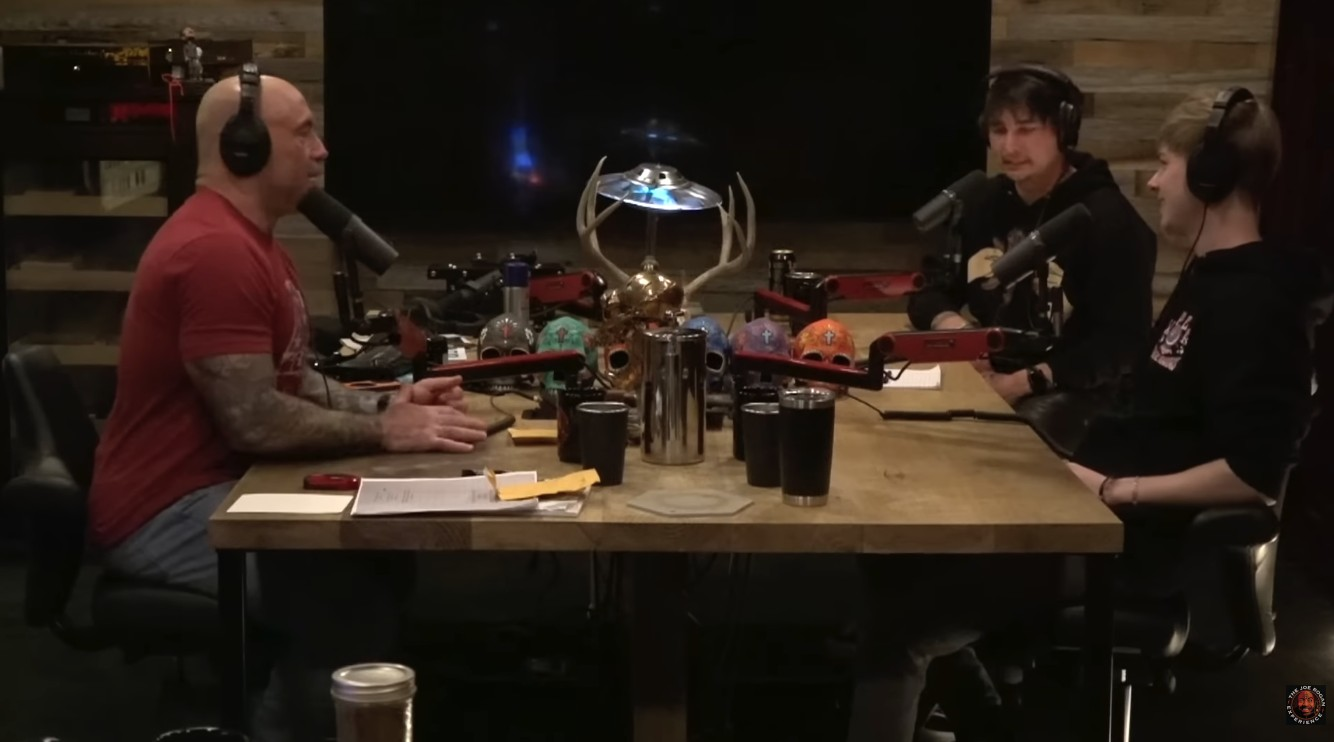
Joe Rogan Experience #1922 – Sam & Colby
Guest: Sam Golbach and Colby Brock · Host: Joe Rogan · YouTube @PowerfulJREIntroduction
Introduction: What Counts as Evidence of the Paranormal?
Paranormal investigation occupies an uneasy space between personal experience and public proof. A door slams in an empty room. A device activates at a seemingly meaningful moment. A voice appears to answer a question through radio static. For the people present, such events can be startling and deeply persuasive. For anyone watching later, however, the central question remains: what does the recording actually establish?
That tension runs throughout The Joe Rogan Experience episode #1922, featuring YouTube creators and paranormal explorers Sam Golbach and Colby Brock. Speaking with host Joe Rogan, the pair recount the experiences that transformed them from skeptical urban explorers into two of the internet’s best-known ghost hunters. Their stories move through the Queen Mary, the Villisca Axe Murder House, the house associated with The Conjuring, Waverly Hills Sanatorium, the Stanley Hotel, and other sites surrounded by histories of death, trauma, and supernatural folklore.
The conversation is compelling because Sam and Colby do not present themselves as scientists, nor do they insist that every unusual event must be paranormal. They acknowledge equipment failures, coincidence, suggestibility, fraudulent mediums, and the commercial incentives surrounding haunted attractions and paranormal media. At the same time, they believe that some sequences—especially apparent responses to direct questions—are too specific to dismiss easily.
Their testimony therefore raises a broader issue. Paranormal content can document what people saw, heard, felt, and recorded, but testimony and footage are not automatically explanations. The most responsible approach is neither reflexive belief nor reflexive ridicule. It is to examine each claim at the level the evidence can support.
Investigation Note
Who Are Sam & Colby?
Sam Golbach and Colby Brock began creating short-form comedy videos before building a large audience around abandoned-place exploration. Their early work emphasized risk, discovery, and the thrill of entering locations most people never see. According to their account, an arrest for trespassing became a turning point. Continuing the same style of exploration was no longer sustainable, so they began seeking locations they could enter legally.
Haunted hotels, historic buildings, and paranormal attractions offered a natural transition. These sites preserved the suspense of abandoned exploration while adding a new question: could the location’s reported history be detected in the present?
Their format evolved into a hybrid of travel documentary, horror entertainment, personal testimony, and amateur investigation. Sam and Colby generally film with a small team, often operating the cameras themselves. That intimacy contributes to the appeal of their work. Viewers witness their reactions in real time and are invited to judge the footage alongside them.
The same production model also creates limitations. A small crew can feel more authentic than a heavily produced television program, but it does not provide independent controls, neutral observers, or repeatable laboratory conditions. Their videos are best understood as records of field experiences—not controlled experiments capable of establishing the existence of ghosts.
Investigation Note
The Queen Mary: The Experience That Changed Their Direction
Sam and Colby identify Room B340 aboard the Queen Mary as the experience that redirected their careers. They say they entered the reputedly haunted room as skeptics and attempted to communicate through knocks. One knock would mean yes, two no, and three uncertain or another designated response.
They report that the knocking continued for roughly 35 minutes, appeared to move to different parts of the room, and at times produced vibrations they could feel through the floor. To them, the most persuasive element was not a single unexplained sound but the apparent relationship between questions and answers.
One exchange had a lasting effect. When they asked whether heaven existed, they heard the response they had assigned to “no.” Religious friends later suggested that a deceptive or malevolent entity might have answered. Sam and Colby did not claim to know whether the sound came from a spirit, something demonic, the ship itself, or an ordinary source they failed to identify. What changed was their willingness to consider that reality might include something beyond their previous assumptions.
The incident is important as personal testimony, but it does not independently prove communication with the dead. Ships contain extensive mechanical systems, pipes, metal structures, neighboring rooms, and changing environmental conditions. Audio can also make direction difficult to judge. Without synchronized measurements and controls, responsive-seeming knocks remain unexplained sounds rather than confirmed messages.
The location’s reputation adds another complication. Room B340 is promoted as a haunted experience, and the Queen Mary has long been surrounded by ghost stories. That does not make every report false, but expectation can shape attention. In a room already framed as paranormal, ordinary sounds are more likely to be noticed, remembered, and interpreted as meaningful.
Investigation Note
Haunted Places as History, Trauma, and Storytelling
Many sites discussed in the episode share a common pattern: real tragedy, incomplete history, later folklore, and commercial retelling become intertwined. Separating those layers is essential.
The Villisca Axe Murder House
At the Villisca house in Iowa, eight people were murdered in 1912, and the crime was never conclusively solved. The brutality of the event is documented history. Claims that spirits remain in the house are interpretations added afterward.
Sam and Colby describe the location as unusually heavy and disturbing. Such feelings are genuine experiences, but they are not measurements of an external presence. Knowing that a family and two young guests were killed in the rooms can produce fear, vigilance, grief, and physical unease even before anything unusual occurs. The building’s emotional force may come from its history, its atmosphere, paranormal activity, or a combination that cannot be cleanly separated.
The House Associated With The Conjuring
The Rhode Island farmhouse made famous by the Perron family, paranormal investigators Ed and Lorraine Warren, and The Conjuring films presents an even more complicated mix. The family’s reported experiences and later paranormal investigations form part of the case record, while the movies are dramatizations designed for entertainment.
Stories surrounding Bathsheba Sherman, often cast as an evil figure in retellings, illustrate why historical verification matters. A repeated legend can become culturally powerful without every detail being supported by reliable records. When a location becomes famous through film, visitors arrive with vivid expectations that can influence how ambiguous events are perceived. Sam and Colby’s interest in these locations is not inherently invalid because the sites are commercial or famous. Yet a responsible account must distinguish a documented death, a witness’s later statement, a film adaptation, and a modern investigator’s interpretation. They are different categories of evidence.
Investigation Note
What Ghost-Hunting Devices Actually Measure
Paranormal investigations often appear technical because they involve electronic devices. Technology can record environmental changes, but a measurement is not the same as an explanation.
EMF Detectors and REM Pods
Sam and Colby describe equipment intended to detect changes in electromagnetic fields. A REM pod creates a field around an antenna and sounds an alarm when that field is disturbed. Investigators sometimes ask an alleged spirit to approach the device or activate it in response to questions.
The confirmed observation in such a case is that the device alarmed. The paranormal interpretation is that an unseen intelligence caused the activation. Between those statements lie numerous possibilities: nearby electronics, wiring, radios, phones, static electricity, movement, battery condition, environmental change, device sensitivity, or malfunction.
Sam and Colby acknowledge this limitation. They say isolated activations are less impressive than repeated responses that correspond to questions. That is a reasonable distinction, but apparent patterns still require controls. Investigators would need to document the device’s sensitivity, exclude known sources of interference, predefine the response protocol, record every trial rather than only successful moments, and reproduce the result.
Motion-Activated “Cat Balls”
Small toys that illuminate when touched or moved are frequently placed on floors in paranormal investigations. If one lights up in an empty room, the event may feel dramatic. Yet the device establishes only that its trigger registered movement or contact. Uneven flooring, vibration, air movement, handling, temperature effects, or mechanical sensitivity may need to be excluded before considering an unknown cause.
Spirit Boxes and the Estes Method
The Estes Method attempts to reduce cueing between an interviewer and a receiver. One participant wears a blindfold and noise-canceling headphones connected to a “spirit box,” which rapidly scans radio frequencies. That person says aloud the words or fragments heard while another person asks questions that the receiver cannot hear. When an utterance seems to answer a hidden question, the sequence can be striking. However, the method also produces a large volume of static, broadcast fragments, partial words, and ambiguous sounds. Human beings naturally search for meaning in incomplete information. A convincing evaluation would require a fixed procedure, complete unedited recordings, independent transcription, enough trials to estimate chance matches, and comparison with sessions conducted where no paranormal claim is expected.
The method may be an interesting experiment, but it is not automatically spirit communication. It produces information that must still be tested against ordinary sources and statistical coincidence.
Investigation Note
The Cases They Find Most Compelling
Across the episode, Sam and Colby return to several incidents that they consider difficult to explain. None provides conclusive proof, but each shows why personal experience can exceed what a recording alone communicates.
The Door at Bowers Mansion
Colby recounts entering a room alone and asking a purported spirit named Bernard to close the door. As he moved toward the exit, the door shut behind him. He describes an immediate emotional reaction and says the experience brought him to tears.
The footage can document the timing of the request, the movement of the door, and Colby’s reaction. It cannot by itself identify the force that moved the door. Air pressure, the building’s structure, hinge angle, an unseen person, or another physical cause would have to be excluded. The close timing makes the moment intriguing; it does not establish agency.
Waverly Hills Sanatorium
At Waverly Hills, a site associated with tuberculosis treatment and extensive death, Colby says a REM pod activated after he moved away from it. The group also discusses footage of a ball apparently rolling, though Sam and Colby clarify that the recording came from friends rather than their own investigation.
This distinction matters. Firsthand footage and third-party material should not be merged into a single body of evidence. For both the electronic activation and the moving object, camera coverage, floor level, airflow, vibration, device condition, and the complete unedited sequence would be necessary for a stronger assessment.
Thermal Imaging and Shadow Figures
Sam and Colby cite a thermal image from the Conjuring House as one of their more persuasive captures. Thermal cameras visualize differences in infrared radiation, usually interpreted as surface-temperature patterns. An unusual human-shaped or moving pattern can warrant investigation, but it does not identify a ghost. Reflections, warm or cool surfaces, people outside the visible frame, calibration behavior, and camera angle can all affect interpretation. They also describe a skeptical guest at the Washoe Club who reported seeing a shadow figure and wanted to leave. The guest’s reaction supports the sincerity of the experience, not the objective identity of what was seen. Low light, peripheral vision, stress, and unfamiliar surroundings can produce misperceptions without dishonesty.
Sincerity and accuracy are separate questions. A witness can be truthful about what an event felt like while remaining mistaken about its cause.
Investigation Note
Haunted Objects and the Power of Expectation
Objects such as Robert the Doll and Annabelle carry stories that precede every visitor. Their reputations become part of the experience.
At the Fort East Martello Museum in Key West, Robert is associated with warnings about disrespect, claims of bad luck, and large numbers of apology letters from visitors. Sam and Colby discuss celebrity stories and the ritual of asking the doll’s permission before taking a photograph. These traditions are documented features of the modern legend; the claim that the doll causes misfortune is not established by the existence of the letters.
Sam describes later becoming nauseated and dry-heaving in a corridor that a guide connected with yellow fever victims. The physical symptoms were real to him. Their cause remains open. Anxiety, heat, dehydration, odor, illness, expectation, or another environmental factor could produce nausea. Linking the reaction to a haunted object or the building’s dead is an interpretation.
Annabelle presents a similar distinction. The physical doll associated with the Warrens exists, while its powers are claims derived from testimony and paranormal belief. The cinematic version is intentionally amplified. Treating the film, the investigators’ account, and the object itself as equivalent evidence would blur three separate things.
These cases reveal how expectation can operate without conscious fabrication. A person who knows an object is reputedly dangerous may monitor every bodily sensation and later connect unrelated misfortune to the encounter. This does not prove that nothing paranormal occurred. It shows why stories about cursed objects are especially difficult to test.
Investigation Note
Belief, Bias, and the Business of Paranormal Content
One of the episode’s most useful moments comes when Sam and Colby acknowledge that they want the paranormal to be real. Evidence of survival after death would expand their view of existence, while haunted investigations also produce excitement, friendship, and compelling stories. That admission does not discredit them. It identifies a motivational bias that should be considered alongside the evidence. Skeptics have biases as well, including a preference for explanations that fit an existing worldview. The goal is not to pretend investigators have no expectations; it is to design methods that prevent expectations from deciding the result.
Commercial incentives deserve the same balanced treatment. Sam and Colby have built a successful entertainment brand around paranormal exploration. Haunted locations benefit from publicity and visitor interest. Dramatic episodes attract viewers. None of this proves staging or deception. It does mean that attention, suspense, and belief are economically valuable, making transparency especially important.
Strong practices would include releasing longer unedited segments, identifying cuts, logging every equipment activation, publishing unsuccessful sessions, documenting environmental conditions, and inviting independent specialists to test devices. These steps would not eliminate entertainment value. They could make an extraordinary claim more credible.
Joe Rogan repeatedly raises the possibility of fraud, wishful thinking, and pattern recognition while remaining open to experiences that do not fit easy explanations. That stance reflects the most productive part of the discussion: witnesses should not be mocked simply because their story is unusual, but unusual stories should not be exempt from scrutiny.
Investigation Note
“Paranormal Hangovers” and Attachments
Sam and Colby describe fatigue, nausea, and emotional depletion after some investigations, calling the experience a “paranormal hangover.” They also discuss fears that an entity or attachment could follow investigators home.
These reports belong in the category of personal experience and paranormal interpretation, not established medical findings. Long shoots, overnight schedules, travel, disrupted sleep, adrenaline, anxiety, poor nutrition, and exposure to old buildings can all produce lingering symptoms. If symptoms are severe or persistent, ordinary medical and environmental causes should be evaluated rather than assumed to be supernatural.
The attachment idea is even harder to test because almost any later misfortune, nightmare, sound, or illness can be folded into the theory. A claim that explains every possible outcome risks becoming impossible to disprove. Investigators who use protective rituals may find them psychologically reassuring, but reassurance is not evidence that an entity was present or repelled.
Investigation Note
What Their Experiences Suggest—and What They Do Not
Sam and Colby are candid that they have not captured an undeniable full-body apparition, witnessed levitation, or obtained evidence that would compel every reasonable observer to accept a supernatural explanation. Most of their case material consists of sounds, feelings, shadows, object movement, and electronic responses.
Those observations can justify continued investigation. They do not yet identify the dead, prove consciousness survives bodily death, or establish that a particular location contains an intelligent entity.
The difference can be summarized clearly:
- Confirmed or independently checkable facts: Sam and Colby visited the locations shown; electronic devices activated; doors or objects moved in recorded sequences; historic tragedies occurred at some sites; and the creators publicly described their reactions and beliefs.
- Documented observations and testimony: They heard knocks, felt vibrations or heaviness, experienced nausea and fatigue, saw ambiguous forms, and perceived meaningful relationships between questions and responses.
- Interpretations: The events may have involved spirits, attachments, communication from the dead, or another form of paranormal intelligence.
- Ordinary alternatives requiring evaluation: Building movement, airflow, electronics, radio broadcasts, device sensitivity, environmental exposure, expectation, incomplete camera coverage, coincidence, and perceptual error.
- Open questions: Whether any event remains anomalous after full controls; whether meaningful response rates exceed chance; whether results can be repeated by independent investigators; and whether the raw recordings support the same conclusions as the edited episodes.
This framework neither dismisses the witnesses nor grants the conclusion in advance. It preserves what is genuinely known while leaving room for discovery.
Investigation Note
The Larger Question: Does Consciousness Continue?
Behind the haunted rooms and alarming devices lies the question that gives paranormal investigation its emotional power: does anything of a person remain after death?
Sam and Colby say the possibility has influenced their spirituality. Their experiences did not give them a settled theology, but they made a purely material view of existence feel less certain. Rogan similarly treats the recurrence of ghost traditions across cultures as worthy of attention, particularly where stories cluster around sudden or traumatic death.
The recurrence of a belief is culturally significant, but it is not proof that the belief is literally true. Human beings everywhere confront death, grief, memory, dreams, and the fear of disappearance. Similar stories may reflect a shared external phenomenon, shared human psychology, or both.
That uncertainty is not a failure. It is the honest boundary of the available evidence. Paranormal research becomes most interesting when it accepts that boundary and asks how it might be tested.
Investigation Note
Conclusion: Curiosity With Standards
Sam and Colby’s appearance on The Joe Rogan Experience offers more than a collection of ghost stories. It shows how extraordinary personal experiences can reshape belief while remaining difficult to translate into public proof.
Their accounts are strongest when they describe precisely what happened, acknowledge uncertainty, and resist claiming more than they observed. They are weakest when emotionally powerful timing or technological aesthetics are treated as evidence of a specific supernatural cause without adequate controls.
The correct response is not to choose between total belief and total dismissal. Haunted locations can be studied as historic places, cultural narratives, psychological environments, and possible sites of unexplained events at the same time. Investigators can respect witnesses while testing devices, preserving raw footage, measuring ordinary variables, and inviting independent replication.
Sam and Colby have not closed the case for life after death. They have documented why the question continues to grip millions of people—and why the next generation of paranormal investigation will need stronger methods if it hopes to move from compelling experience to convincing evidence.
Investigation Note
Key Takeaways
- Sam and Colby’s shift from urban exploration to paranormal content followed an arrest for trespassing and a powerful experience in Room B340 aboard the Queen Mary.
- They describe themselves as open-minded investigators who acknowledge coincidence, equipment failure, fraud, and uncertainty.
- Their most memorable evidence involves apparent responses to questions, including knocks, door movement, EMF-based alarms, spirit-box words, shadows, and thermal imagery.
- Electronic equipment records physical or radio-frequency changes; it does not identify a spirit without additional evidence.
- The history of a location, its folklore, commercial promotion, and visitors’ expectations can influence how ambiguous events are interpreted.
- Sincere testimony establishes what a witness experienced, not necessarily what caused the experience.
- Their small-team production style creates immediacy but lacks independent controls and neutral verification.
- Their desire for the paranormal to be real, along with the economics of entertainment, should be disclosed and considered without being mistaken for proof of deception.
- Unedited footage, predefined protocols, environmental monitoring, control sessions, and independent replication would make future claims more persuasive.
- The episode leaves the survival of consciousness as an open question rather than a demonstrated conclusion.
Investigation Note
Questions for Further Exploration
- Could the Queen Mary knocking sequence be repeated under synchronized audio, vibration, and environmental monitoring?
- How often do REM pods, motion-activated toys, and similar devices trigger in control locations over the same period?
- Would independent reviewers identify the same words and question matches in blind Estes Method recordings?
- How much do prior knowledge and location reputation affect reported fear, bodily sensations, and perceptions of anomalous events?
- Can investigators publish complete logs of successful and unsuccessful trials to reduce selection bias?
- What historical claims attached to famous haunted locations are supported by primary records, and which emerged through later folklore?
- Could thermal-camera anomalies be reproduced through reflections, calibration changes, body heat, or off-camera movement?
- What safeguards should paranormal creators use when discussing illness, attachments, or cursed objects with vulnerable viewers?
- Would collaboration with acousticians, electricians, psychologists, historians, and statisticians strengthen field investigations?
- What evidence would be sufficient to distinguish an unexplained event from communication by a conscious, nonphysical agent?