Primary Source
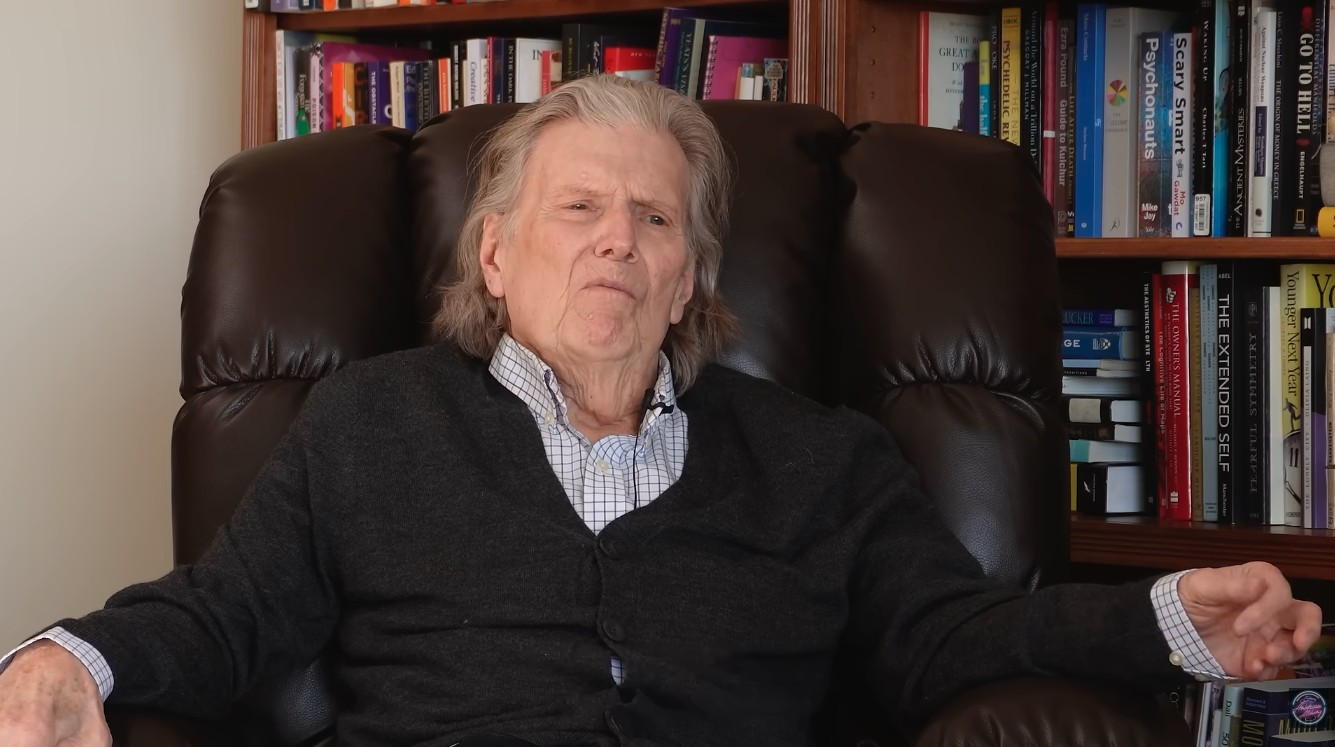
Presidential Advisor: “I Directly Handled UFO Material” (Ft. Harald Malmgren)
Guest: Harald Malmgren · Host: Jesse Michels · YouTube @JesseMichelsIntroduction
Introduction: An Extraordinary Account at the End of a Remarkable Life
Harald Malmgren spent his career near the machinery of power. An economist, diplomat, trade negotiator, and adviser to multiple United States presidents, he moved through Cold War strategy, international economics, intelligence relationships, and unofficial diplomatic channels. His public résumé places him in rooms where decisions carried global consequences.
That background is what makes his final interview with Jesse Michels so arresting. In a nearly four-hour presentation released by the American Alchemy channel, Malmgren discusses more than government service. He says he directly handled anomalous debris associated with a 1962 nuclear test, received information about unconventional technology from senior CIA official Richard Bissell, heard of an alleged 1933 crash near Magenta, Italy, and encountered references to a high-level group connected with the term “Majestic.” He also reflects on telepathy, classified science, nuclear danger, personal purpose, and the possibility that his life was connected with time travel.
Malmgren died on February 13, 2025, at age 89. The interview therefore carries the emotional force of a final testimony. It also presents a serious evidentiary challenge. His stature and proximity to officials make his recollections worthy of attention, but credentials cannot independently verify events for which no public physical evidence, contemporary record, or living corroborating witness is available.
The proper response is neither dismissal nor automatic belief. It is to preserve exactly what Malmgren said, identify what can be checked, and separate the documented history surrounding his account from the conclusions Michels draws from it.
Investigation Note
Who Was Harald Malmgren?
Harald Bernard Malmgren was born in 1935 and studied at Yale and Oxford before entering a career in economics, defense analysis, diplomacy, and trade policy. His obituary describes him as a senior adviser to Presidents John F. Kennedy, Lyndon B. Johnson, Richard Nixon, and Gerald Ford. He later became known for his work on international trade, global markets, and strategic affairs.
In the interview, Malmgren recounts an unusual path into elite circles. As a young student, he pursued scientific information with exceptional intensity and developed relationships with senior academics and government-connected figures. He describes being noticed early, brought into consequential work, and repeatedly used as an unofficial intermediary because he could operate outside rigid bureaucratic channels.
Michels interprets this pattern as more than professional talent. He wonders whether Malmgren was identified and cultivated by a hidden network concerned with nuclear technology and non-human intelligence. Malmgren speaks of having a purpose and sometimes feeling guided, but he does not provide a complete institutional account of who selected him or why.
Two propositions must therefore remain distinct. Malmgren demonstrably had an extraordinary career and access to senior officials. The claim that a secret UFO-related body followed or recruited him from youth is an interpretation built from his recollections and Michels’s pattern analysis.
Investigation Note
The Cuban Missile Crisis: History, Memory, and a Young Adviser
The documentary opens with Malmgren’s account of the Cuban Missile Crisis. He says Secretary of Defense Robert McNamara brought him into a tense discussion and tasked him with slowing an aggressive military argument. Malmgren recalls challenging Air Force Chief of Staff General Curtis LeMay about the consequences of a first strike, pressing the problem that destroying Moscow would leave no leadership with whom to negotiate. According to Malmgren, LeMay angrily left the exchange.
The broad historical setting is firmly documented. In October 1962, Soviet nuclear missiles in Cuba brought the United States and Soviet Union dangerously close to war. McNamara, LeMay, the Joint Chiefs, President Kennedy, and other officials debated blockade, air strikes, invasion, and escalation. Declassified records show deep disagreement between civilian leaders and military commanders.
Malmgren’s specific role in the described confrontation is based primarily on his later testimony. Michels presents it as an example of a young adviser helping prevent catastrophe. The interview does not supply a contemporaneous meeting transcript naming Malmgren in that precise exchange.
This does not make his memory false. Sensitive work is often incompletely documented, and unofficial participants may not appear in formal minutes. Yet the difference matters. The Cuban Missile Crisis is confirmed history; Malmgren’s intervention is a firsthand recollection within that history. Describing him as someone who single-handedly “saved the world” goes beyond what the available public record can establish.
Investigation Note
Operation Fishbowl and the Debris Malmgren Says He Handled
The interview’s central claim concerns the 1962 high-altitude nuclear testing program known as Operation Fishbowl. Malmgren says he was shown unusual debris connected to material that fell after a test in the Marshall Islands. When Michels asks whether he saw images or physical material, Malmgren answers that it was debris and says he handled it directly.
He describes the material as strange because it did not feel as expected. The documentary connects the object to a reported craft or “tagalong” near a missile and advances the possibility that a nuclear detonation or associated weapons system brought down a UAP.
Several layers are present:
- Documented context: The United States conducted high-altitude nuclear tests in 1962, including Starfish Prime and other Operation Fishbowl events. The tests produced significant electromagnetic and radiation effects, and some damaged satellites.
- Malmgren’s testimony: He says he directly handled anomalous material associated with the aftermath of one of these tests.
- Attributed briefing: He says information from Richard Bissell helped frame the material and surrounding technology as otherworldly.
- Michels’s interpretation: The debris may have come from a non-human craft disabled during a nuclear test or missile-defense experiment.
The last conclusion requires evidence not included in the episode. No sample is available for independent analysis. There is no public chain-of-custody record connecting a specific object in Malmgren’s hands to a tracked craft, nuclear plume, or recovery team. No laboratory report establishes composition, manufacture, or non-human origin.
Malmgren’s statement remains important because it is unusually direct. It is still testimony, not a publicly verified material finding.
Investigation Note
Richard Bissell and the Alleged Briefing on “Otherworld Technologies”
Richard M. Bissell Jr. was one of the most powerful covert-operations officials of the Cold War. The historical record confirms that he directed the CIA’s U-2 reconnaissance program, oversaw development efforts that led to the A-12 OXCART aircraft, and served as Deputy Director for Plans. He operated at the intersection of intelligence, advanced aerospace technology, and extreme secrecy.
Malmgren says Bissell spoke with him about capabilities and research that he understood as “otherworld technologies.” He also says Bissell mentioned the alleged 1933 Magenta crash in Italy. Michels argues that Bissell’s known position makes the account especially consequential: if anyone could have known about hidden aerospace programs or recovered technology, Bissell was well placed.
Access, however, is not corroboration. Bissell’s documented role supports the plausibility that he knew classified aerospace secrets. It does not independently establish what he told Malmgren or whether he described technology as extraterrestrial, non-human, foreign, experimental, or merely anomalous.
The conversation also faces the problem of terminology. “Otherworld” can imply literal origin beyond Earth, but it may also be a listener’s summary of technology so advanced that it seemed outside ordinary experience. A stronger record would require Malmgren’s exact notes, a contemporary document, another participant, or a surviving Bissell source.
What the episode establishes is that Malmgren attributed extraordinary information to Bissell. It does not establish that Bissell’s statements were accurate or that the technology’s origin was known.
Investigation Note
The 1933 Magenta Crash: A Claim Before Roswell
The alleged Magenta incident concerns a craft said to have crashed in northern Italy in 1933 under Benito Mussolini’s regime. Later versions of the story describe a secret investigative organization, Italian custody of the object, wartime intelligence activity, and eventual American acquisition.
Malmgren tells Michels that Bissell mentioned the Magenta crash. That matters because it is presented as separate support for a story later associated with UAP whistleblower David Grusch and Italian UFO researchers.
Yet independent verification remains limited. The existence of fascist-era memoranda or later copies does not alone prove that a non-human craft was recovered. Documents require authentication, provenance, comparison with archival records, and evaluation for fabrication or postwar mythmaking. The episode offers a network of people who could conceivably have moved technology from Italy to the United States, but a plausible pathway is not proof that a particular object traveled through it.
The careful conclusion is narrow: Malmgren says a senior CIA official referred to a 1933 event at Magenta. That is a significant attributed recollection. The crash, the craft’s origin, and its alleged transfer to American custody remain unverified in the public record.
Investigation Note
“Majestic,” Secret Committees, and the Problem of Names
Malmgren uses the word “Majestic” in discussing high-level structures around sensitive science and non-human intelligence. Michels connects the reference to Majestic 12, the alleged committee said to have managed UFO recovery and secrecy after Roswell.
The public Majestic 12 story is controversial. Documents naming such a group have circulated for decades, while authenticity disputes and signs of possible fabrication have prevented broad historical acceptance. The term may also have been used in counterintelligence, compartment names, continuity planning, or informal descriptions unrelated to the famous twelve-person committee.
Michels eventually offers a more restrained possibility: Malmgren may have been referring to a genuine high-level group dealing with catastrophic contingencies, including nuclear events, with UAP as only one part of its work. Governments do create restricted committees whose names, membership, and subcommittees change over time.
This interpretation fits Malmgren’s career more comfortably than a single permanent council governing all UFO matters. Still, the episode does not identify a charter, membership list, budget, or document tying his use of “Majestic” to a specific organization.
The responsible distinction is simple: Malmgren used the term and believed important people were connected. The existence and scope of the popular “MJ-12” organization remain unproven.
Investigation Note
Nuclear Weapons and UAP: Monitoring, Baiting, or Misidentification?
The interview repeatedly returns to an alleged relationship between nuclear technology and UAP. Michels cites accounts of unusual objects near weapons facilities, missile tests, launch systems, and nuclear accidents. Malmgren entertains the possibility that another intelligence monitors humanity’s most dangerous technologies and may act as a steward of Earth.
The documentary goes further in places, suggesting that nuclear tests may have been used to attract, track, disable, or recover UAP. It proposes that an object near a test could have been affected by a warhead, electromagnetic disturbance, radiation, or experimental defensive technology.
These possibilities must be separated by evidence:
- Unknown objects near nuclear sites are legitimate security concerns.
- Military tests naturally employ radar, optical tracking, telemetry, and classified systems, increasing the chance that ambiguous events are detected.
- Balloons, instrumentation packages, missile debris, atmospheric effects, foreign surveillance, and sensor artifacts are conventional alternatives.
- Testimony describing intelligent interference with missiles is more specific but requires records and independent corroboration.
- The conclusion that UAP are non-human guardians—or targets deliberately baited by nuclear activity—is speculative.
The repeated association is worth systematic study. A meaningful analysis would compare UAP reporting rates at nuclear and non-nuclear installations, control for sensor coverage and secrecy, preserve full telemetry, and evaluate each incident independently. A pattern may justify a hypothesis; it does not identify the actor behind it.
Investigation Note
Back Channels: How Sensitive Government Work Actually Moves
Malmgren’s stories about unofficial diplomacy provide important context for evaluating the rest of his testimony. He describes presidents and senior officials using trusted individuals to carry messages outside embassies, formal cables, and normal agency processes. Such channels can reduce leaks, bypass institutional rivalry, and give leaders deniability.
These recollections show why the absence of a conventional paper trail is not always decisive. Governments sometimes act through personal relationships. A participant may know something consequential without holding a document that can later be released.
At the same time, back-channel culture makes historical verification harder. Private conversations are vulnerable to memory changes, misunderstood language, and later interpretation. An unofficial channel can explain missing records, but it cannot itself verify what supposedly happened.
This is the central paradox of Malmgren’s account. His career makes private access plausible. The private nature of that access limits what later researchers can prove.
Investigation Note
Tesla, Townsend Brown, and Technologies Beyond Accepted Physics
The later conversation turns toward Nikola Tesla and Thomas Townsend Brown. Malmgren expresses admiration for experimental inventors and suggests that hands-on discovery can reach beyond the boundaries imposed by prevailing theory. He questions what remained hidden in Tesla’s papers and explores Brown’s work on high-voltage systems, unconventional propulsion, and possible transmutation.
Michels links those ideas to antigravity and time. In general relativity, gravity and time are related, but that scientific relationship does not establish that Brown created a time machine. Brown’s publicly demonstrated high-voltage devices can produce electrohydrodynamic thrust in air. Claims of gravity control, reactionless propulsion, element transmutation, or time manipulation require repeatable controlled experiments.
Malmgren is more exploratory than declarative. When asked whether Brown discovered antigravity, he says he does not know and that he is still reviewing material. This answer should govern the section. The episode documents Malmgren’s interest in a neglected line of research, not a confirmed breakthrough.
The larger question is valuable: how much promising experimentation was classified, abandoned, misunderstood, or buried because it did not fit dominant theory? Answering it requires recovering laboratory records and repeating experiments—not inferring success from secrecy alone.
Investigation Note
Telepathy, Remote Viewing, and the Meaning of “Purpose”
Malmgren speaks openly about intuitive experiences. He describes his mother as unusually perceptive and says he sometimes felt a guiding influence directing him left or right. The discussion connects these experiences to telepathy, remote viewing, and government research into anomalous cognition.
The United States did fund remote-viewing research. That fact demonstrates institutional interest, not reliable psychic intelligence. Later official evaluation concluded that the results were too inconsistent and subjective for dependable operational use.
Near the end of his life, Malmgren tells Michels he believed he had a purpose. Michels interprets the repeated synchronicities of Malmgren’s career—scientific mentors, presidential service, nuclear crises, intelligence figures, and late interest in UAP—as evidence of deliberate guidance.
The statement is profound as personal testimony. It is not a testable institutional claim. Purpose can be understood spiritually, psychologically, biographically, or literally as direction from an external intelligence. The interview leaves those meanings unresolved.
Investigation Note
Time Travel and the Final “Yes”
The documentary closes with its most enigmatic exchange. Michels asks whether Malmgren believed his life was connected with time travel. Malmgren says he had considered the question many times and answers yes, without elaboration.
Michels places the answer beside a novel written by a former CIA officer, in which a gifted young man joins a secret committee, receives information about future timelines, and discovers a hidden purpose. The narrative parallels are evocative, but fiction is not evidence that the novel encoded Malmgren’s life or revealed an actual program.
Nor does Malmgren define “connected.” He may have meant literal temporal technology, forecasting, strategic management of possible futures, synchronicity, or a metaphysical understanding of his life. Because he declined to explain, no single interpretation should be assigned to him.
The final answer is best preserved as an open question. Its power comes from its ambiguity; its ambiguity is also why it cannot carry a factual conclusion.
Investigation Note
What the Evidence Supports—and What Remains Unverified
The episode can be evaluated through clear categories:
- Confirmed facts: Malmgren was a prominent economist, diplomat, trade official, and presidential adviser; the Cuban Missile Crisis involved severe disagreement over military action; Operation Fishbowl conducted high-altitude nuclear tests in 1962; Richard Bissell directed major CIA aerospace programs and served as Deputy Director for Plans; governments use classified research and unofficial back channels.
- Malmgren’s firsthand testimony: He says he participated in a crucial crisis discussion, handled anomalous debris, received unusual information from Bissell, encountered the term “Majestic,” experienced intuitive guidance, and believed his life was connected with time travel.
- Attributed statements: Bissell allegedly discussed otherworld technology and the Magenta incident. These claims survive through Malmgren’s recollection rather than a public Bissell record.
- Michels’s investigative interpretation: Malmgren may have been cultivated by a hidden committee; a UAP may have been disabled during a nuclear test; Magenta material may have reached American programs; and Malmgren’s life may mirror a concealed timeline-management project.
- Unverified conclusions: The debris was non-human; MJ-12 governed UAP secrecy; nuclear weapons were used to bait or shoot down craft; retrieved technology transformed industry; telepathy guided Malmgren; or literal time travel shaped his career.
- Open questions: Do laboratory reports or chain-of-custody records survive? Can other participants confirm the Bissell briefing? Are authentic Italian archives available for the Magenta claim? What did Malmgren mean by “Majestic” and “time travel”? Which classified records can now be released?
Malmgren’s testimony should not be reduced to proof or dismissed as fantasy. It is a high-value historical lead whose most extraordinary elements still require corroboration.
Investigation Note
Conclusion: The Weight—and Limits—of Final Testimony
Harald Malmgren’s interview is compelling because the speaker was not an anonymous storyteller. He had a documented career spanning presidential administrations, international negotiations, defense analysis, and relationships with powerful people. His familiarity with secrecy, nuclear strategy, and unofficial government channels was real.
That background raises the value of his testimony, but it does not remove the need for evidence. Memory at the end of a long life can preserve genuine secrets, compress separate events, or attach later language to earlier experiences. Michels’s documentary sometimes moves quickly from Malmgren’s brief answers to an elaborate network of historical interpretation. Those connections are best treated as research directions, not completed findings.
The interview’s enduring contribution may be the set of records it invites researchers to seek: Operation Fishbowl recovery and anomaly reports; Malmgren’s schedules and correspondence; Bissell’s scientific briefings; Atomic Energy Commission files; Italian wartime archives; national-laboratory material analyses; and records of contingency committees that may have used the word “Majestic.”
Malmgren ended his life believing that it had purpose. Whether that purpose was geopolitical, spiritual, or connected to a reality stranger than conventional history allows remains unknown. His account deserves preservation because of who he was, scrutiny because of what he claimed, and humility because the evidence does not yet resolve the mystery.
Investigation Note
Key Takeaways
- Harald Malmgren had a documented career as an economist, diplomat, trade negotiator, and adviser to several U.S. presidents.
- His specific role in confronting Curtis LeMay during the Cuban Missile Crisis is a personal recollection rather than a fully corroborated public record.
- Malmgren said he physically handled anomalous debris associated with a 1962 high-altitude nuclear test.
- No publicly available sample, laboratory report, or complete chain of custody establishes that the debris came from a non-human craft.
- Richard Bissell’s leadership of major CIA aerospace programs is documented; the alleged UFO and Magenta briefing comes through Malmgren’s testimony.
- The 1933 Magenta crash remains an unverified claim requiring authenticated Italian and American archival evidence.
- Malmgren’s use of “Majestic” may refer to a secret committee, a broader contingency structure, or another compartment; it does not independently prove the popular MJ-12 narrative.
- UAP reports near nuclear facilities deserve serious study, but monitoring, baiting, shootdown, and stewardship theories remain distinct hypotheses.
- Classification and presidential back channels can create genuine gaps in the public record without proving extraterrestrial involvement.
- Malmgren expressed interest in Tesla and Townsend Brown but did not claim that Brown’s antigravity work was conclusively proven.
- Government remote-viewing research confirms official investigation, not dependable telepathy or psychic intelligence.
- Malmgren’s final statements about purpose and time travel are meaningful testimony whose intended meaning remains undefined.
Investigation Note
Questions for Further Exploration
- Do declassified meeting records, calendars, or memoirs place Malmgren in the Cuban Missile Crisis exchange he described?
- What recovery, tracking, and anomaly records survive from Operation Fishbowl and the relevant Marshall Islands test?
- Was the debris Malmgren handled cataloged, photographed, analyzed, or retained?
- Can any living witness or contemporary document corroborate Bissell’s alleged briefing?
- Are the documents associated with the 1933 Magenta story authentic, and can their provenance be established?
- What organizations or compartments used “Majestic” as an official or informal term?
- Do UAP reports occur disproportionately near nuclear facilities after controlling for sensor density and military activity?
- Which technologies often described as appearing without an “on-ramp” actually lack a traceable research history?
- Can Brown’s strongest propulsion experiments be reproduced under modern vacuum and measurement controls?
- What did Malmgren mean when he said his life was connected with time travel?
- Did Malmgren leave private papers, recorded interviews, or instructions that clarify his final disclosures?
- How should historians weigh elite firsthand testimony when physical evidence and contemporary documentation remain unavailable?