Primary Source
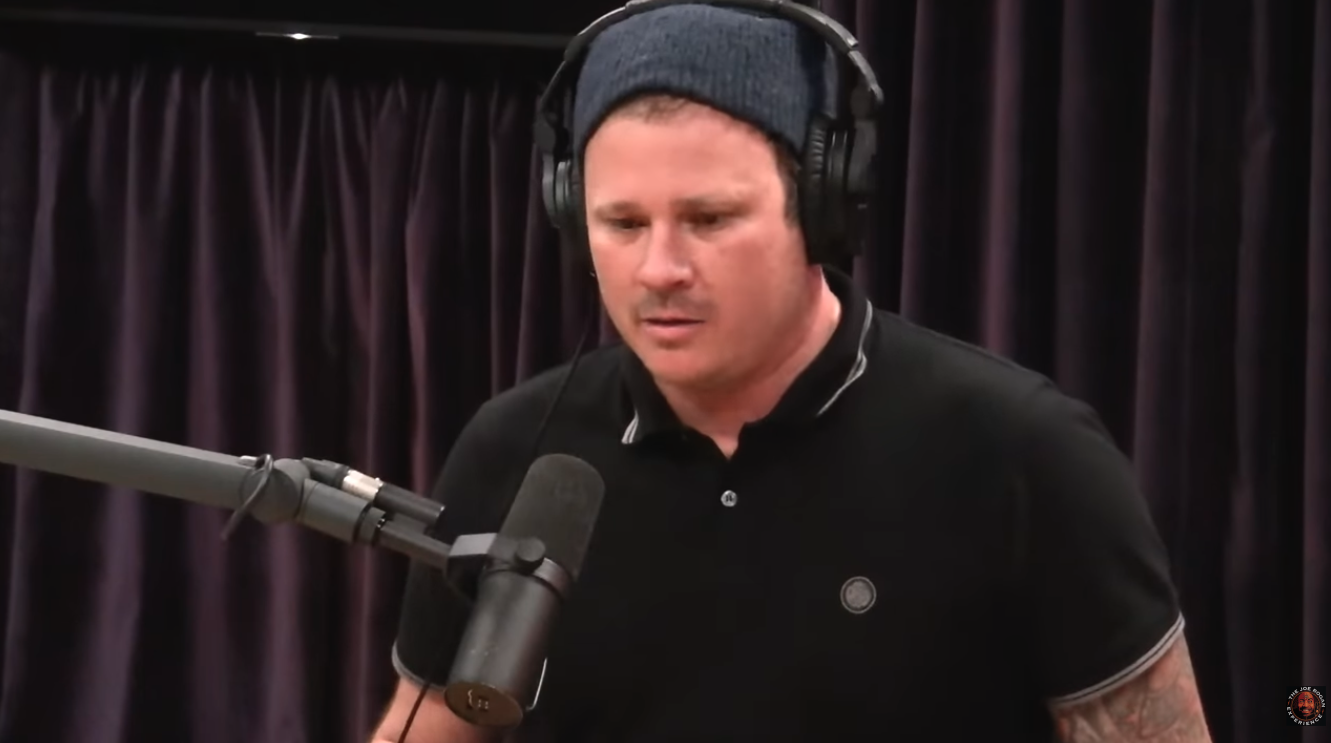
Joe Rogan Experience #1029 — Tom DeLonge
Guest: Tom DeLonge · Host: Joe Rogan · YouTube @PowerfulJREIntroduction
Introduction: When a Rock Star Entered the UFO Disclosure World
In October 2017, Tom DeLonge appeared on The Joe Rogan Experience to discuss a subject that had come to define the next stage of his career: UFOs, government secrecy, advanced aerospace technology, and the possibility that humanity has misunderstood the phenomenon for decades.
To much of the public, DeLonge was best known as a founding member of Blink-182. His sudden involvement with former military, intelligence, and aerospace officials therefore seemed improbable. During the interview, however, he described years of private research, meetings with senior government-connected figures, and an ambitious organization intended to combine entertainment, science, aerospace engineering, and public education.
The conversation took place at an unusual moment. DeLonge repeatedly insisted that important information was moving toward public disclosure, but many of the claims he discussed had not yet been supported by evidence available to the public. Joe Rogan challenged him throughout the episode, asking for clearer explanations, verifiable documentation, and reasons to trust unidentified sources.
The result is one of the most controversial UFO interviews in the podcast’s history.
DeLonge presents a sweeping theory involving crashed objects, Cold War secrecy, hidden aerospace programs, consciousness, time manipulation, ancient mythology, nuclear weapons, and competing non-human intelligences. Some parts of the discussion concern established historical events and real defense programs. Others depend on private conversations, disputed material, or DeLonge’s personal interpretation of information he says he received from insiders.
This article examines the episode as a snapshot of the UFO disclosure movement before it entered a more public phase—separating what was verifiable, what DeLonge said he had been told, and what remained speculation.
Investigation Note
Who Is Tom DeLonge?
Tom DeLonge is a musician, songwriter, entrepreneur, author, and longtime UFO researcher. He became internationally famous through Blink-182 and later performed with Angels & Airwaves.
His interest in UFOs began much earlier.
During the interview, DeLonge tells Rogan that he became fascinated by unexplained phenomena while still in junior high school. He discovered books concerning UFOs, cryptozoology, and unusual historical cases, then continued reading during long drives while touring with his band.
What began as curiosity became a decades-long investigation.
DeLonge says he gradually concluded that the UFO phenomenon could not be understood by studying unusual objects alone. In his interpretation, it involved military history, religion, consciousness, mythology, advanced physics, psychological operations, and national security.
He also claims that his celebrity gave him unusual access. Rather than approaching officials as a traditional journalist, scientist, or political activist, he presented himself as someone capable of communicating difficult information through books, films, music, and popular culture.
That strategy eventually became the foundation of To The Stars Academy of Arts & Science, the organization DeLonge had recently announced when the Rogan interview was recorded.
Investigation Note
Why DeLonge Calls UFOs “Advanced Aerial Threats”
At the beginning of the episode, DeLonge avoids the traditional term “UFO” and refers instead to “advanced aerial threats.”
Rogan immediately focuses on the word threat.
DeLonge initially hesitates to explain, suggesting that the terminology reflects how military and intelligence officials approach unidentified objects operating in restricted or strategically important airspace.
The threat designation does not necessarily mean that every unexplained object is hostile. From a defense perspective, an unidentified craft becomes a potential threat when it can:
- Enter controlled airspace without authorization
- Evade detection or interception
- Demonstrate capabilities beyond known aircraft
- Approach military installations or nuclear facilities
- Interfere with weapons or communication systems
- Operate without an understood chain of command DeLonge’s language also reveals his broader interpretation. He does not believe the phenomenon should automatically be portrayed as friendly extraterrestrial visitors arriving to help humanity.
Instead, he suggests that the intelligence behind some encounters may be manipulative, deceptive, or engaged in a long-term effort to influence human civilization.
Confirmed Principle
Unknown aircraft operating near military assets would reasonably be treated as a national-security concern until identified.
DeLonge’s Interpretation
He believes at least some UFO events involve non-human technology and should be studied as both a scientific mystery and a possible security threat.
Unresolved Question
The presence of an unidentified object does not, by itself, establish extraterrestrial origin or hostile intent.
Investigation Note
How DeLonge Says He Reached Government Insiders
One of the episode’s central questions is how a musician became connected with former military and intelligence officials.
DeLonge says he spent years developing a detailed interpretation of UFO secrecy and then traveled to Washington, D.C., to present his ideas. He describes contacting individuals connected with aerospace, defense, and intelligence institutions and explaining that the government’s public relationship with the UFO subject had become dysfunctional.
According to DeLonge, his argument was that secrecy may once have been considered necessary, particularly during the Cold War, but decades of ridicule and denial had created a serious credibility problem.
He says he proposed a new approach:
Rather than suddenly announcing the entire truth, officials could work with a public-facing organization that introduced the subject gradually through credible experts, scientific projects, fiction, documentaries, and educational media.
DeLonge portrays himself as a bridge between classified institutions and a younger public audience.
Rogan repeatedly presses him on whether the people advising him are genuine insiders or whether DeLonge could be misinterpreting their authority. DeLonge responds that the résumés and positions of the people involved demonstrate their credibility, even when he cannot disclose everything they told him.
This creates a recurring problem throughout the interview: source credibility is offered in place of publicly accessible evidence.
A highly qualified source may deserve attention, but expertise and status do not automatically verify every claim attributed to that person.
Investigation Note
To The Stars Academy: Science, Entertainment, and Aerospace
DeLonge describes To The Stars Academy of Arts & Science as an organization designed to operate across three major divisions:
- Science
- Aerospace
- Entertainment The science division would investigate unusual materials, consciousness, and phenomena associated with UFO encounters.
The aerospace division would attempt to develop advanced propulsion or transportation technologies based on unconventional physics.
The entertainment division would introduce complex ideas through films, books, television, and other media.
DeLonge argues that these elements belong together. A scientific paper may reach specialists, but popular culture can prepare millions of people to consider unfamiliar ideas. Entertainment, in his view, is not merely promotional—it is part of a long-term public-education strategy.
Rogan remains skeptical, particularly when DeLonge discusses raising money from the public while withholding many details. He questions whether the organization can deliver on claims involving advanced technology and whether its projects are scientifically realistic.
The exchange highlights a tension that still affects private UFO research:
How can an organization ask for public trust and funding while claiming that important evidence cannot yet be revealed?
Investigation Note
The Officials and Scientists Presented by DeLonge
DeLonge emphasizes that his organization includes individuals with backgrounds in aerospace engineering, defense, intelligence, and government research.
He specifically discusses Steve Justice, a former senior figure associated with Lockheed Martin’s Skunk Works advanced-development programs. DeLonge presents Justice’s involvement as evidence that To The Stars is not simply a celebrity UFO project.
Skunk Works is associated with historically significant aircraft programs, making the presence of a former advanced-aerospace engineer noteworthy.
DeLonge also refers to scientists and former officials with experience in subjects including:
- Advanced propulsion
- Materials science
- Intelligence analysis
- Biological effects
- National security
- Government investigations of anomalous phenomena The presence of qualified people can make an investigation more credible, but it does not automatically validate its most extraordinary hypotheses. Experienced professionals may join speculative projects for many reasons, including curiosity, research freedom, entrepreneurial opportunity, or belief that a question deserves study.
The key issue remains whether their work produces testable, independently verifiable results.
Investigation Note
The Cold War and the Origins of Secrecy
DeLonge places the modern UFO secrecy system within the historical conditions of the Cold War.
He asks the audience to imagine government officials discovering an unknown life-form or advanced technology while the United States and Soviet Union were locked in a nuclear confrontation.
In that environment, any extraordinary discovery would immediately become a strategic issue.
Officials would need to consider:
- Whether the phenomenon represented a foreign breakthrough
- Whether recovered technology could be weaponized
- Whether an adversary possessed similar material
- Whether public disclosure could create panic
- Whether the information would expose classified detection systems
- Whether the phenomenon itself could manipulate political or military decisions DeLonge argues that decisions made during the Cold War should be understood within that period’s fear, secrecy, and competition.
He does not simply accuse all government personnel of participating in a single malicious cover-up. Instead, he describes a fragmented system in which different groups possessed different pieces of information and acted according to their own responsibilities.
This is one of the episode’s more grounded observations. “The government” is not one unified mind. Military branches, intelligence agencies, contractors, presidents, scientists, and elected officials may hold conflicting views and different levels of access.
DeLonge’s Larger Theory
He believes secrecy began partly as a legitimate national-security response but eventually developed into a system that became difficult to reverse.
Remaining Question
Even when secrecy can be historically explained, that does not prove the underlying material involved non-human technology.
Investigation Note
Roswell, Crashed Objects, and Competing Accounts
The Roswell incident becomes a recurring subject.
In 1947, military personnel recovered material near Roswell, New Mexico. An initial public statement referred to a “flying disc,” but the military soon identified the debris as a weather balloon. Later explanations connected the event with Project Mogul, a classified balloon effort intended to detect Soviet nuclear testing.
DeLonge believes the official explanation is incomplete.
He speaks as though at least one extraordinary object was recovered and suggests that some information surrounding Roswell became part of a deeply classified system.
Rogan challenges him to explain why reliable physical evidence has not emerged after so many decades.
DeLonge responds by distinguishing between public folklore and the more complicated version allegedly known within insider circles. He suggests that some famous UFO stories contain truth mixed with deliberate misinformation, mistaken details, and false leads.
This makes the claim difficult to test. When evidence supports the story, it can be treated as confirmation. When it conflicts, it can be interpreted as disinformation.
A responsible investigation must avoid creating a theory that explains every possible result and therefore cannot be disproven.
Confirmed
- An unusual military recovery occurred near Roswell in 1947.
- The military’s first public statement referred to a flying disc.
- The explanation changed shortly afterward.
- The event later became one of history’s most famous UFO cases.
- Project Mogul was a real classified balloon program.
DeLonge’s Belief
He believes the Roswell event involved technology or material that cannot be fully explained by the official account.
Unverified
The episode does not provide public physical evidence proving that a non-human spacecraft or biological entity was recovered at Roswell.
Investigation Note
Alleged Materials From UFO Crashes
DeLonge discusses metal or material allegedly recovered from unusual crashes.
He describes samples with layered structures or properties that investigators believe may be difficult to reproduce through ordinary manufacturing. In his account, electrical or electromagnetic stimulation could potentially produce unusual effects.
The conversation moves into ideas involving specially engineered materials whose atomic construction could interact with energy, gravity, or spacetime.
Rogan asks whether DeLonge has personally seen definitive proof.
DeLonge says he has been shown or told enough to believe that some material is genuine, but much of the supporting analysis remains unavailable during the conversation.
This is one of the most important areas where clear evidence could potentially move the subject forward.
A material sample can be tested through:
- Isotopic analysis
- Elemental composition
- Microscopic imaging
- Layer structure
- Manufacturing signatures
- Thermal behavior
- Electrical conductivity
- Magnetic response
- Chain of custody
- Comparison with known industrial materials An unusual composition would not automatically prove extraterrestrial origin. It could represent an experimental alloy, industrial waste, terrestrial technology, contamination, or a misunderstood manufacturing process.
The strongest evidence would require independent laboratories reaching compatible conclusions without knowing the preferred explanation in advance.
Investigation Note
Advanced Propulsion and the Manipulation of Spacetime
DeLonge argues that the apparent movement of UFOs may not result from conventional propulsion.
Instead of accelerating through the atmosphere like an aircraft or rocket, an advanced craft might manipulate gravity, inertia, or spacetime around itself.
He describes a concept in which a vehicle changes the surrounding environment rather than forcing itself through it. From the occupants’ perspective, the craft may remain relatively stable while space is altered around it.
This idea is often used to explain reported UFO characteristics such as:
- Sudden acceleration
- Right-angle turns
- No visible exhaust
- Lack of sonic booms
- Movement between air and water
- Apparent disappearance
- Extreme speed without observable structural damage Some concepts involving spacetime distortion exist within theoretical physics. That does not mean practical craft using those concepts have been demonstrated.
The engineering barriers would be immense, involving energy requirements, control systems, exotic materials, and unresolved questions about gravity.
DeLonge’s Claim
He believes the phenomenon uses a form of physics capable of manipulating space, time, and gravity.
Scientific Distinction
A theoretical possibility is not equivalent to a working technology. The episode offers no publicly testable device demonstrating such propulsion.
Investigation Note
The Proposed Aerospace Vehicle
DeLonge says To The Stars intends to pursue an advanced aerospace vehicle.
The project is described using concepts involving an electromagnetic structure, specialized materials, and unconventional propulsion.
Rogan expresses doubt that a newly formed public-benefit corporation could realistically build technology far beyond existing aircraft and spacecraft.
DeLonge responds that the organization’s role is to combine experts, intellectual property, funding, and research that have previously remained separated.
He appears confident that the underlying principles are known, even though significant engineering work remains.
This creates another important distinction:
There is a difference between proposing a research program and possessing the technology required to complete it.
A serious aerospace project would eventually need to demonstrate measurable milestones such as:
- A validated physical model
- Repeatable laboratory effects
- Energy requirements
- Controllable force generation
- Peer-reviewed results
- Prototype testing
- Independent verification Without these stages, a revolutionary craft remains an aspiration rather than an established development.
Investigation Note
Consciousness as Part of the UFO Phenomenon
DeLonge repeatedly argues that UFOs cannot be understood solely as machines.
He believes consciousness plays a central role in how the phenomenon interacts with people and reality.
The episode touches on reports involving:
- Telepathic impressions
- Altered states of awareness
- Perception changes
- Psychological manipulation
- Religious experiences
- Apparitions
- Unusual effects on witnesses
- Interaction between consciousness and materials DeLonge suggests that advanced technology may work partly through principles that modern science currently places in separate categories.
In this model, physics, consciousness, and spirituality are not isolated subjects. They are aspects of one deeper system.
Rogan remains cautious, noting that extraordinary mental experiences can also result from dreams, drugs, neurological conditions, suggestion, false memory, and cultural expectations.
Both possibilities deserve consideration.
Witnesses frequently report that UFO encounters feel simultaneously physical and psychological. The unresolved question is whether that mixture reflects an external intelligence affecting consciousness, the brain responding to a confusing experience, or some combination of the two.
Confirmed
Human perception and memory are influenced by stress, expectation, sleep, trauma, and neurological conditions.
DeLonge’s Belief
Some non-human intelligence possesses technology or abilities that directly interact with human consciousness.
Open Question
Can consciousness influence physical reality in ways not explained by current neuroscience and physics?
Investigation Note
Time Manipulation and the Nature of the Craft
DeLonge claims that the phenomenon may involve time travel, although he says the mechanism differs from popular science-fiction portrayals.
He suggests that the occupants of advanced craft may experience time differently from outside observers. A craft that manipulates gravity or spacetime could produce unusual time effects without traveling through history in the familiar cinematic sense.
Time dilation is a real consequence of relativity. Time can pass at different rates depending on velocity and gravitational conditions.
DeLonge extends this established principle into highly speculative territory, suggesting that advanced vehicles may deliberately control these effects.
Such a capability could theoretically help explain reports of:
- Missing time
- Objects appearing and disappearing
- Extreme movement
- Witnesses experiencing events differently
- Apparent predictions or foreknowledge
- Encounters that seem detached from ordinary chronology However, the episode provides no direct experimental evidence that UFOs manipulate time.
The hypothesis is possible within DeLonge’s larger model, but it remains unconfirmed.
Investigation Note
UFOs and Nuclear Weapons
The relationship between UFO reports and nuclear sites is one of the episode’s most serious themes.
DeLonge refers to incidents in which unidentified objects allegedly approached nuclear facilities or interfered with weapons systems.
He interprets this pattern as evidence that the phenomenon closely monitors humanity’s most destructive technology.
Reports involving UFOs and nuclear installations have circulated for decades. Former military personnel have described unexplained aerial activity near missile facilities, weapons-storage areas, and nuclear tests.
Interpretations differ significantly.
The incidents could represent:
- Foreign surveillance
- Misidentified aircraft
- Instrument failure
- Secret domestic technology
- Psychological or intelligence operations
- Coincidence
- Unidentified natural phenomena
- Non-human monitoring DeLonge believes nuclear weapons are central to the relationship between humanity and the intelligence behind UFOs.
He also speculates that nuclear conflict may affect more than the physical environment, possibly disturbing dimensions or forms of reality not yet understood.
That extension is not scientifically established.
What Can Be Investigated
Specific incidents can be examined through military records, radar data, witness testimony, maintenance logs, and facility documentation.
What Remains Unproven
No publicly established evidence demonstrates that non-human entities have activated, disabled, or manipulated nuclear weapons.
Investigation Note
Did the UFO Phenomenon Influence the Cold War?
DeLonge suggests that unidentified intelligence may have played a role in preventing the Cold War from becoming a full nuclear exchange.
He speculates that UFO activity around nuclear systems may have sent a message to both the United States and Soviet Union: neither side had complete control over its most powerful weapons.
Within his theory, the phenomenon may provoke conflict while also preventing humanity from destroying itself.
This apparent contradiction becomes part of DeLonge’s larger “control system” model.
He believes unexplained entities may influence civilizations through:
- Fear
- Religious experiences
- Technological inspiration
- Conflict
- Mythology
- Apparitions
- Political manipulation
- Demonstrations of superior power Rather than openly ruling humanity, the intelligence may guide events indirectly.
This theory resembles ideas proposed by other UFO writers who view the phenomenon as a long-term influence on human belief and behavior.
It remains speculative. Historical tensions can be explained through human politics, economics, ideology, military strategy, and diplomacy without invoking non-human intervention.
Investigation Note
The Phenomenon as a Control System
One of DeLonge’s most important ideas is that UFO events form part of a “control system.”
He does not portray sightings as random visits from scientific explorers.
Instead, he suggests that different events occur at specific times to steer humanity in particular directions. Some displays may be designed to inspire. Others may create fear, division, or religious belief.
He proposes that the phenomenon has influenced human civilization for thousands of years by presenting itself in forms appropriate to each culture.
Ancient societies may have interpreted the entities as gods, angels, demons, or spirits. Modern societies interpret them as extraterrestrials and spacecraft.
Within this theory, the appearance changes while the underlying intelligence remains the same.
This could explain why UFO narratives often resemble older religious and mythological encounters.
It could also result from the opposite process: modern witnesses may interpret ambiguous experiences through the cultural language already available to them.
The similarity between ancient and modern stories is real as a subject of comparative mythology. The cause of that similarity remains debated.
Investigation Note
Greek Gods, Ancient Civilizations, and UFO Mythology
DeLonge discusses Greek mythology and suggests that some ancient gods may have represented interactions with advanced beings.
He connects stories of gods descending from the sky, teaching humanity, fighting among themselves, and possessing extraordinary weapons with modern interpretations of non-human intelligence.
He also refers to symbols allegedly associated with recovered UFO material and claims that some markings resemble ancient Greek writing.
At one point, he discusses a purported piece of Roswell debris bearing symbols interpreted as an ancient Greek word connected with freedom.
Rogan challenges the reliability of photographs and objects circulating online, noting how easily evidence can be fabricated or misrepresented.
That skepticism is necessary.
Confirmed
- Greek mythology contains accounts of powerful humanlike gods interacting with humanity.
- Ancient cultures frequently described celestial beings, divine vehicles, and supernatural weapons.
- Modern UFO interpretations sometimes compare these stories with contact narratives.
DeLonge’s Interpretation
He believes some myths may preserve distorted memories of real encounters with non-human intelligence.
Unverified
No authenticated Roswell artifact containing ancient Greek writing has been publicly established as non-human material.
Investigation Note
Religion, Gods, and Competing Non-Human Groups
DeLonge’s theory extends beyond the idea that ancient people mistook extraterrestrials for gods.
He suggests that the beings may have intentionally created or shaped religious systems to influence humanity.
Different groups of entities could have presented competing belief structures, encouraged conflict, and manipulated civilizations over long periods.
In this framework, religious stories may contain fragments of genuine encounters but have been filtered through culture, politics, symbolism, and later interpretation.
This idea raises difficult questions.
Religious experiences are deeply personal and culturally diverse. Explaining all religion as alien manipulation would be an enormous claim requiring extraordinary evidence.
A more cautious conclusion is that religious and UFO narratives sometimes share recurring features:
- Beings descending from the sky
- Brilliant lights
- Messages or prophecies
- Altered states
- Missing time
- Healing or injury
- Fear and awe
- Instructions to witnesses
- Promises of transformation Those parallels warrant comparative study, but they do not prove a common non-human source.
Investigation Note
Good Aliens, Bad Aliens, or Something More Complicated?
DeLonge resists the popular image of uniformly peaceful extraterrestrials.
He claims there may be multiple non-human groups with different agendas. Some could be more helpful to humanity, while others may exploit fear, conflict, or division.
He suggests that human history has been influenced by competition between these intelligences.
This theory offers an explanation for why reported encounters range from comforting and transformative to frightening and traumatic.
It also creates a major evidentiary problem. Without direct access to the alleged beings, researchers cannot reliably determine:
- How many groups exist
- Where they originate
- What their motives are
- Whether witnesses encounter separate entities or interpret similar experiences differently
- Whether apparently benevolent behavior is genuine or deceptive
- Whether frightening experiences involve external beings at all DeLonge argues that this uncertainty is one reason the subject should be approached as a potential threat rather than a purely spiritual awakening.
Investigation Note
The United States, the Soviet Union, and Possible Cooperation
DeLonge speculates that the United States and Soviet Union may have quietly communicated or cooperated regarding the UFO issue despite their public hostility.
He reasons that if both nuclear superpowers encountered the same unexplained intelligence, they would share an interest in preventing misunderstanding.
An unidentified object approaching a weapons facility could otherwise be mistaken for an enemy attack, increasing the risk of nuclear escalation.
Governments have historically maintained emergency communication channels to prevent accidental war. It is therefore reasonable that unusual aerospace incidents could become part of military risk assessment.
However, DeLonge goes further by suggesting that the UFO problem may have influenced high-level geopolitical decisions and possibly contributed to the Cold War remaining cold.
No direct evidence supporting that conclusion is presented during the episode.
Investigation Note
Nazis, Secret Technology, and Postwar Programs
The conversation briefly examines Nazi technology and the transfer of German scientists to the United States following World War II.
Operation Paperclip brought German scientists and engineers into American programs, including individuals who later contributed to rocketry and space exploration.
That historical fact has fueled theories that Nazi researchers possessed unconventional propulsion technology or recovered knowledge connected to UFOs.
DeLonge suggests that postwar aerospace developments may have intersected with discoveries involving unusual craft.
This area requires careful separation.
Confirmed
- The United States recruited German scientists after World War II.
- Some former Nazi Party members or collaborators entered American scientific and military programs.
- German engineers had developed advanced rockets and aircraft.
Speculative
- Nazi Germany possessed operational antigravity vehicles.
- German programs recovered non-human technology.
- Postwar American aerospace breakthroughs resulted from extraterrestrial material. The existence of advanced wartime research does not establish a connection with UFOs.
Investigation Note
Mars, Ancient Nuclear War, and Lost Civilizations
The episode eventually expands beyond Earth.
DeLonge says he believes life exists or once existed on Mars. He discusses claims that unusual isotopes in the Martian atmosphere or surface could indicate ancient nuclear explosions.
The theory proposes that an advanced civilization may once have inhabited Mars and suffered a catastrophic nuclear event.
Rogan asks for supporting evidence, and the conversation refers broadly to scientific discussions and researchers who have promoted the hypothesis.
Evidence of radiation, isotopes, or geological destruction would not automatically demonstrate warfare. Natural processes, cosmic radiation, volcanic activity, asteroid impacts, and atmospheric evolution must also be considered.
Confirmed
- Mars shows evidence of a more geologically and climatically active past.
- Scientists continue to investigate whether ancient Mars could have supported microbial life.
- The planet contains unusual geological and atmospheric features.
DeLonge’s Belief
He believes Mars may have hosted intelligent life and possibly experienced an ancient nuclear catastrophe.
Unverified
There is no accepted evidence proving that an intelligent Martian civilization destroyed itself with nuclear weapons.
Investigation Note
Atlantis and the Possibility of Forgotten Human History
DeLonge also touches on Atlantis and lost civilizations.
He suggests that humanity may have experienced previous periods of advanced development that were later destroyed or forgotten.
Stories of Atlantis, catastrophic floods, ancient gods, and technological gifts could, in his interpretation, preserve traces of an earlier relationship with non-human intelligence.
The historical record does contain examples of civilizations being lost, abandoned, buried, or rediscovered. Human prehistory is incomplete, and archaeology continues to revise timelines and assumptions.
However, the existence of undiscovered history does not validate every lost-civilization theory.
Reasonable Position
Important archaeological discoveries may still change our understanding of ancient societies.
Speculative Extension
An advanced global civilization existed in deep antiquity and possessed technology comparable to—or beyond—modern civilization.
No conclusive evidence for such a technological civilization is presented in the interview.
Investigation Note
DeLonge’s Fiction as a Form of Disclosure
DeLonge explains that his Sekret Machines project combines fiction and nonfiction to communicate ideas he believes are connected with real events.
The fictional format allows complex themes to be presented without claiming that every scene happened exactly as described.
He argues that storytelling can introduce audiences to:
- Secret aerospace programs
- Intelligence operations
- UFO encounters
- Consciousness effects
- Ancient history
- Competing non-human groups
- The psychological burden of secrecy This approach has advantages and risks.
Fiction can make complicated subjects accessible and encourage readers to consider unfamiliar possibilities. It can also blur the boundary between documented events and narrative invention.
For research purposes, any claim inspired by a fictional story must eventually be traced back to independent evidence.
Entertainment may lead people to a question. It cannot serve as proof of the answer.
Investigation Note
Joe Rogan’s Central Challenge: Where Is the Evidence?
Throughout the episode, Rogan repeatedly asks DeLonge to move from broad claims to specific evidence.
He questions photographs shown on DeLonge’s phone, asks whether videos could be computer-generated, and challenges claims that rely on unnamed insiders.
At times, DeLonge appears frustrated because he believes Rogan is focusing on individual pieces of evidence rather than the larger network of people and projects he has assembled.
Rogan’s objection is methodological.
A claim should not become credible merely because:
- A source holds an impressive title
- A photograph appears unusual
- A story is classified
- Multiple rumors reinforce one another
- A technology is theoretically possible
- A person appears sincere Evidence must be authenticated and independently evaluated.
This tension defines the interview.
DeLonge believes he is describing the early stages of a historic disclosure process. Rogan treats the available presentation as insufficient to support the conclusions being offered.
Both perspectives are important to understanding the episode.
Investigation Note
Why Insider Testimony Is Valuable—but Not Enough
DeLonge relies heavily on conversations with people he describes as senior officials or experts.
Insider testimony can be valuable. People with direct access may know information unavailable to the public, and historically significant wrongdoing has sometimes first emerged through confidential sources.
But insider testimony introduces several risks:
- The source may be mistaken.
- The source may exaggerate their access.
- Information may be secondhand.
- The source may be conducting a psychological operation.
- Classified context may be misunderstood.
- DeLonge may interpret cautious language too confidently.
- Different insiders may hold conflicting beliefs.
- Accurate facts may be mixed with deliberate misinformation. DeLonge himself acknowledges that disinformation has surrounded the UFO subject.
That admission makes verification even more important. If the information environment contains deliberate deception, personal access alone cannot determine which claims are true.
Investigation Note
Could DeLonge Have Been Used?
Rogan raises the possibility that DeLonge’s fame and enthusiasm could make him useful to government-connected individuals pursuing their own agenda.
DeLonge accepts that manipulation is possible but argues that he has spent years studying the subject and evaluating the people involved.
Several possible explanations can coexist:
- DeLonge genuinely reached well-informed officials.
- Those officials sincerely believe some UFO claims.
- Some information provided to him may be accurate.
- Some may be speculation circulating within government circles.
- Some could be part of an influence campaign.
- DeLonge may have been selected because he could reach a large audience.
- The organization may represent an authentic effort to create public discussion. Being associated with powerful people does not automatically mean a person is being deceived. It also does not eliminate the possibility.
The only reliable way forward is to evaluate each claim through evidence rather than trust the network as a whole.
Investigation Note
Confirmed Facts, Personal Beliefs, and Speculation
Confirmed Facts
- Tom DeLonge is a musician and longtime UFO enthusiast.
- He founded an organization combining entertainment, scientific research, and aerospace ambitions.
- The organization publicly involved former officials and professionals with backgrounds in defense, intelligence, and aerospace.
- Governments have historically investigated unidentified aerial phenomena.
- Military organizations treat unknown objects in sensitive airspace as potential security concerns.
- Roswell involved the recovery of material by the U.S. military in 1947, followed by conflicting public explanations.
- The Cold War produced extensive secrecy surrounding aerospace, nuclear, and intelligence programs.
- Operation Paperclip brought German scientists into American programs after World War II.
- Time dilation and the relationship between gravity and spacetime are established aspects of physics.
- Reports of unidentified objects near nuclear facilities have been made by former military personnel.
Tom DeLonge’s Personal Beliefs
- Some UFOs represent advanced non-human technology.
- The phenomenon has influenced humanity for thousands of years.
- Multiple non-human groups may have competing agendas.
- Some ancient gods and religious beings may have been manifestations of the phenomenon.
- UFO secrecy began partly for legitimate Cold War security reasons.
- Recovered materials have contributed to secret research.
- Consciousness is central to the operation and effects of the phenomenon.
- Advanced craft manipulate gravity, time, or spacetime.
- His generation is meant to help bring the subject into public awareness.
- To The Stars could help bridge classified knowledge and public understanding.
Claims Attributed to Insiders
- Government-connected groups possess information about recovered craft or biological entities.
- Specialized programs have investigated advanced aerial threats and related effects.
- Unusual materials from alleged crashes have been analyzed.
- Senior officials support a gradual disclosure process.
- Some aspects of the UFO issue involve capabilities beyond ordinary aerospace technology. These claims may reflect genuine conversations, but the episode does not provide enough documentation to verify their complete meaning or accuracy.
Speculation and Theories
- Roswell involved a non-human spacecraft.
- Ancient gods were non-human intelligences.
- Religious systems were deliberately shaped by competing entities.
- UFOs function as a control system guiding human civilization.
- Non-human intelligence helped prevent nuclear war.
- Secret programs reverse-engineered recovered technology.
- Specialized materials can manipulate gravity or spacetime.
- Ancient Mars hosted an intelligent civilization destroyed by nuclear war.
- Atlantis represented a technologically advanced civilization.
- Some intelligence groups intentionally prepared DeLonge to lead public disclosure.
- Fiction and entertainment are being used as part of an organized acclimation process.
Open Questions
- What exactly were DeLonge’s sources authorized to tell him?
- Did he receive direct evidence or mainly verbal briefings?
- Can alleged crash materials be independently tested?
- What were the objectives and findings of the government programs he referenced?
- Are UFOs physical craft, consciousness-related events, or both?
- Why are unidentified objects repeatedly reported near nuclear facilities?
- Can unconventional propulsion concepts produce measurable laboratory results?
- Are similarities between ancient mythology and modern UFO reports evidence of a shared source or recurring human psychology?
- Was DeLonge helping facilitate disclosure, being influenced by insiders, or experiencing some combination of both?
- Which of the episode’s claims can now be evaluated through documents released after the interview?
Conclusion
Conclusion: A Controversial Interview at the Edge of Disclosure
Tom DeLonge’s appearance on The Joe Rogan Experience is difficult to evaluate as an ordinary interview.
He arrived with extraordinary confidence, described access to powerful officials, and outlined a hidden history of UFOs touching nearly every major institution and mystery of human civilization.
He also appeared before much of the supporting information had entered public discussion.
That timing made him look either remarkably well-connected, dangerously overconfident, deliberately manipulated, or some combination of the three.
The episode’s greatest weakness is its lack of immediately verifiable evidence. DeLonge frequently asks the audience to trust that qualified people know more than they can presently say. For a subject shaped by decades of secrecy, hoaxes, and misinformation, that is not enough.
Its greatest significance is that DeLonge was publicly describing a network involving former government, intelligence, and aerospace figures while arguing that the UFO issue was about to re-enter legitimate national conversation.
The interview should not be treated as proof of crashed spacecraft, non-human beings, ancient intervention, or revolutionary propulsion technology.
It should be treated as a historical record of what DeLonge believed he had learned—and of the unusual disclosure effort he was attempting to launch.
The ultimate question is not whether every theory presented in the episode is correct. Many remain unsupported or highly speculative.
The more important question is whether DeLonge had genuinely encountered a group of influential insiders preparing to change how the public understood UFOs.
That question would soon become much harder to dismiss.
Investigation Note
Key Takeaways
- Tom DeLonge describes UFOs as potential “advanced aerial threats” because unidentified craft may operate within sensitive airspace and around military assets.
- He claims his celebrity and long-term research helped him establish relationships with former defense, intelligence, and aerospace officials.
- To The Stars Academy was designed to combine science, aerospace engineering, and entertainment as part of a gradual public-education effort.
- DeLonge believes Cold War secrecy shaped the government’s approach to UFOs and made later transparency extremely difficult.
- He argues that some UFOs use technology capable of manipulating gravity, inertia, spacetime, and consciousness.
- Claims involving recovered craft, unusual materials, and secret programs depend heavily on insider testimony within the episode.
- DeLonge connects modern UFO reports with ancient mythology, religion, nuclear weapons, and theories of long-term influence over humanity.
- Rogan consistently challenges the authenticity of the evidence and the reliability of unnamed sources.
- Qualified officials participating in an organization can increase its credibility, but their involvement does not prove its most extraordinary claims.
- The episode is most valuable as a record of the early public phase of DeLonge’s disclosure initiative, not as conclusive evidence of his larger theory.
Investigation Note
Questions for Further Exploration
- What information did DeLonge receive directly, and what reached him through secondhand sources?
- Which claims from the interview were later supported by documents, official statements, or independently verified evidence?
- Could unusual materials from alleged UFO incidents be studied through transparent, multi-laboratory testing?
- Why would government insiders choose a musician and entertainment company as part of a disclosure strategy?
- How can the public distinguish genuine whistleblowers from misinformation, rumor, and institutional mythology?
- Do UFO reports near nuclear facilities show intelligent monitoring, foreign surveillance, technical malfunction, or coincidence?
- Could advanced propulsion explain the extreme movements described by military witnesses without violating known physics?
- Are religious and mythological parallels evidence of non-human influence or recurring patterns in human consciousness?
- Can an organization combine entertainment and research without blurring the boundary between fact and fiction?
- Was DeLonge revealing a genuine transition toward transparency—or becoming part of a new method of controlling the UFO narrative?