Primary Source
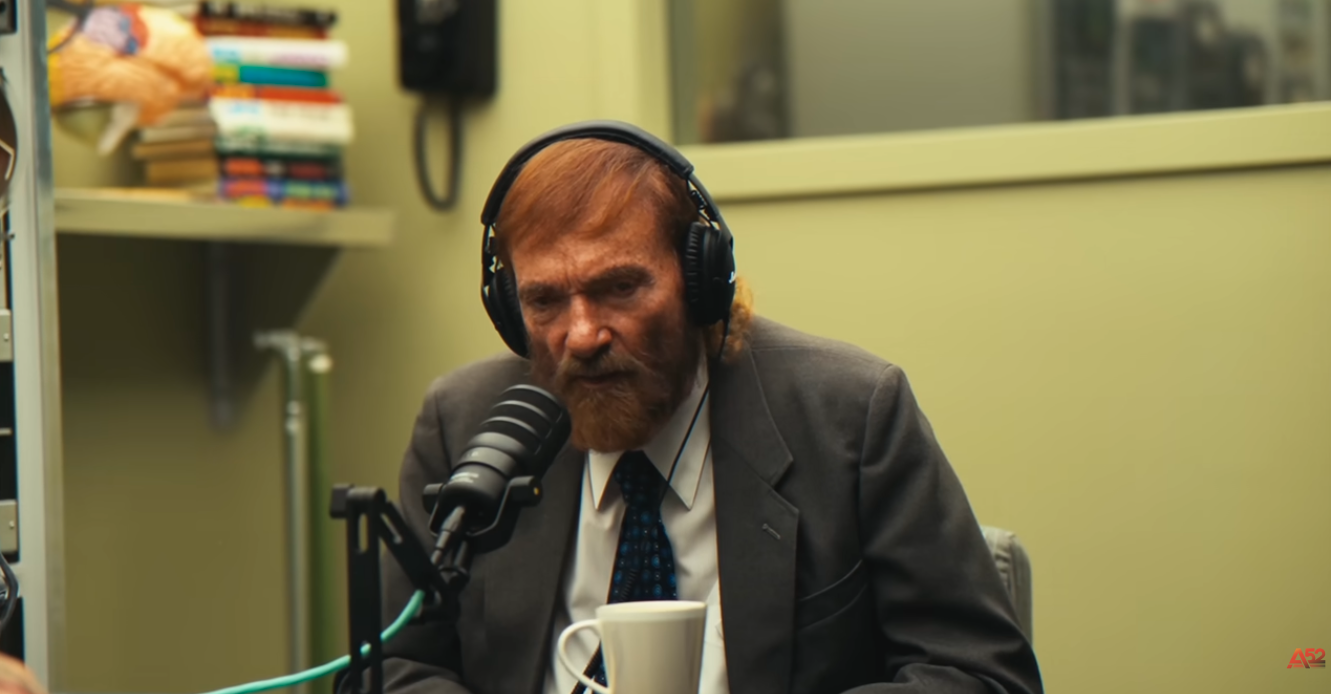
Area 52 — Travis Walton Interview
Guest: Travis Walton · Host: Chris Ramsay · YouTube @Area52Introduction
Introduction: An Extraordinary Case Under Examination
On November 5, 1975, seven forestry workers were driving home through Arizona’s Apache-Sitgreaves National Forest when, according to their later accounts, they saw a bright object hovering among the trees. One of them, 22-year-old Travis Walton, got out of the truck and approached it. His coworkers said a brilliant discharge struck him and threw him backward. Terrified, they fled. When they returned, Walton was gone.
Walton remained missing for five days and six hours. His disappearance triggered a law-enforcement investigation and a large search. When he reappeared, he said he had awakened in an unfamiliar interior, confronted small nonhuman figures, encountered human-looking beings, and lost consciousness again before finding himself beside a highway.
The story became one of the most famous alleged alien-abduction cases in modern history and inspired the 1993 film Fire in the Sky. Yet familiarity has often obscured the case’s real evidentiary structure. The crew’s claimed observation is not the same thing as Walton’s account of what happened during his absence. A missing-person investigation does not establish an extraterrestrial cause. Polygraph results—positive, negative, and disputed—cannot settle the matter. And the frightening scenes invented or altered for the film should not be confused with Walton’s testimony.
In an extended Area 52 interview, Walton revisits the event nearly half a century later. He describes what he says he saw, separates some memories from later interpretations, and explains why he no longer views the incident primarily as a hostile attack. His account remains extraordinary and unverified. But the interview also reveals why the case endures: it combines multiple witnesses, a real disappearance, a public investigation, a contested testing history, personal trauma, and unanswered questions that neither belief nor dismissal can resolve by itself.
Investigation Note
A Case Larger Than a Single Witness
The incident began at the end of a workday in the national forest near Heber, Arizona. Walton was part of a seven-man logging crew led by Mike Rogers. As the men traveled along a forest road, they reportedly noticed an intense glow through the trees and then saw a luminous, disc-like object hovering nearby.
Walton says curiosity and impulse drove him out of the truck. As he moved closer, he recalls the object becoming louder and more active. The crew’s account is that a bright beam or energetic discharge struck him, knocking him down. Believing Walton had been killed, Rogers accelerated away. The men soon decided to return, but Walton and the object were no longer there.
The workers reported Walton missing, placing themselves under immediate suspicion. Law enforcement had an obvious reason to consider an ordinary crime: six men had returned from a remote worksite without the seventh and were telling an extraordinary story. Authorities interviewed the crew, investigated the disappearance, and participated in searches of the surrounding area.
That distinction matters. It is established that Walton was reported missing and that authorities searched for him. It is documented that the crew attributed his disappearance to an unusual aerial object. But those facts do not independently establish what the object was, whether its apparent discharge caused Walton’s disappearance, or where he spent the following five days.
The multiple-witness component nevertheless makes the case more substantial than a solitary report. Six coworkers said they saw an unusual object and the apparent impact on Walton. Their testimony created a shared observational claim that could be compared across interviews. At the same time, group testimony is not equivalent to instrumented evidence. No publicly established photograph, video, radar record, or recovered material confirms the object’s presence.
Investigation Note
Five Days and Six Hours of Missing Time
Walton says he remembers only a small fraction of the period during which he was absent. In the Area 52 interview, he acknowledges the enormous gap between the duration of his disappearance and the events he can consciously recall. He initially assumed he had been unconscious—or possibly near death—for most of that time.
After his return, Walton made a collect call asking his family for help. Navajo County Sheriff’s Office history records that the telephone operator recognized the missing man’s name and alerted the sheriff. Family members collected him near Heber. Walton says he was confused, physically weak, and emotionally overwhelmed.
The missing interval remains one of the case’s central problems. Walton offers no continuous account of those five days. He mentions later dreams or fragments involving the more human-looking figures, but says they never formed a clear, coherent sequence. This restraint is significant because it limits what can responsibly be claimed. The gap cannot simply be filled with an assumption that he remained aboard a craft throughout his absence.
Other possibilities have been proposed, ranging from an unrecognized medical or dissociative episode to deliberate concealment or a staged hoax. None has been conclusively demonstrated in the material discussed in the episode. The practical question—where Walton was, and how he survived during that interval—remains unresolved.
Investigation Note
Walton’s Account of Awakening Inside an Unknown Environment
Walton says his first clear memory after being struck was awakening on a narrow surface beneath a bright light. He felt severe pain in his head and chest and believed he might be dying. Around him were three small figures with large eyes, small mouths, and hairless heads.
His immediate interpretation was terror. He associated their appearance with threatening creatures and believed they might be responsible for his condition. He says he grabbed a clear, solid, rod-like object from a nearby surface and used it to keep them at a distance. Other objects resembled instruments, although he did not claim to know their purpose. He also states that he was not aware of punctures or obvious injuries to his skin.
Walton recalls the smaller figures leaving the area. He then moved through a passage and entered a larger space containing a central chair or control-like station beneath a curved, star-patterned surface. In the interview, he describes manipulating part of the chair and perceiving a change in the surrounding display, though he does not claim to understand what the system was or what he may have activated.
He then says a human-looking man wearing a helmet entered. Walton tried to communicate, but the figure did not answer. The man led him to another room where several other human-looking individuals were present, including a woman. Walton describes them as healthy, strong, and unusually similar in appearance, but not artificial. He remembers being placed on a table and having a mask positioned over his face. His next memory is awakening outdoors near a road.
Looking upward, Walton says he saw a polished, silvery object rise rapidly and disappear. He then recognized the nearby town and reached a telephone.
Every detail in this onboard sequence comes from Walton’s personal testimony. The coworkers did not witness it. No publicly established recording or physical artifact independently confirms the interior, the beings, the instruments, the mask, or the departing craft. The account may be sincere without being objectively verified; those are separate questions.
Investigation Note
From “Attack” to “Accident and Rescue”
One of the interview’s most important themes is the evolution of Walton’s own interpretation. In the years immediately after the incident, he understood the flash as a weapon and the beings as hostile abductors. He now regards that as a fear-driven misconception.
Walton’s current hypothesis is that he approached too closely and triggered an unintended energy discharge—perhaps a defensive system, an automatic reaction, or an effect associated with the craft’s operation. He speculates that the occupants took him aboard because he had been seriously injured and attempted to repair the damage before returning him.
His reasoning is retrospective. He argues that if the occupants intended to kill him or conceal the event, they could simply have disposed of his body. Instead, on his account, they returned him alive and apparently without lasting physical injury. He further theorizes that the human-looking figures were brought in because his panic made cooperation with the smaller beings impossible.
This reinterpretation may offer a coherent narrative, but it is not a remembered explanation given by the alleged occupants. Walton reports no clear communication of motive. “Accident,” “rescue,” and “medical recovery” are his attempts to infer purpose from the sequence as he remembers it. Alternative interpretations remain possible, including the possibility that his perceptions do not describe a literal extraterrestrial environment.
The distinction between experience and interpretation is especially important here. Walton can report that he felt pain, saw figures, reached for an object, and later found himself by a highway. He cannot directly establish why any of it happened, what technology was involved, or what the beings intended.
Investigation Note
Trauma, Hypnosis, and the Reliability of Memory
Walton describes the aftermath less as an adventure than as a long psychological burden. He says he regretted leaving the truck and wished the event had never happened. Family life and work later helped ground him. For years, he immersed himself in long hours at mills, partly to keep his mind occupied and partly because he feared delayed physical consequences.
Soon after his return, Walton underwent hypnosis. He says the hypnotist encouraged him to recount the event from an observer’s perspective rather than reliving it directly. Walton credits that technique with reducing his stress and helping him speak about the memory.
That therapeutic benefit does not make hypnosis a reliable tool for establishing historical fact. Memory is reconstructive, especially after trauma, repeated interviews, suggestion, media exposure, and the passage of decades. Hypnosis can increase confidence and narrative detail without guaranteeing accuracy. Therefore, details recalled or elaborated under hypnosis require greater caution than independently documented observations made near the time of an event.
The transcript does not always specify which details were available before hypnosis, which emerged during sessions, and which developed through later reflection. A rigorous future study would compare Walton’s earliest recorded statements, hypnosis transcripts, his original book, later editions, and successive interviews. Stability would not prove the account, but changes could reveal how memory and interpretation evolved.
Walton himself recognizes at least part of this boundary. He says that when he speculates, he tries to identify what he does not know directly. He also acknowledges that there are matters he does not discuss because he cannot substantiate them or does not believe discussing them would help.
Investigation Note
The Polygraphs: Important History, Not Scientific Proof
Polygraph examinations have shaped public debate around the Walton case from the beginning. In the Area 52 interview, Walton emphasizes that crew members passed law-enforcement-related polygraph testing and refers to multiple later tests as support for their accounts.
The complete history is more complicated. Most members of the logging crew received results interpreted as supporting their denial of harming Walton, although at least one early result was inconclusive. Walton also underwent an early private examination after his return that the examiner reportedly judged deceptive. That unfavorable result has been disputed on the basis of Walton’s condition and the test’s administration. Walton later received results interpreted as favorable.
Even a clean and consistent set of results would not prove an alien encounter. A polygraph measures physiological responses—not lies themselves. Anxiety, exhaustion, trauma, question wording, examiner technique, expectations, and deliberate countermeasures can affect the result. A major National Academies review concluded that specific-incident tests can perform above chance under some conditions but remain well below perfect and are difficult to generalize from controlled research to real-world cases.
The fairest conclusion is limited. The crew’s results may have influenced investigators’ assessment of whether the men had murdered Walton, and the men’s willingness to be tested is part of the historical record. But the tests cannot identify the object, establish an abduction, validate Walton’s onboard memories, or exclude every form of deception or error. The unfavorable, inconclusive, and favorable outcomes all belong in an evidence-conscious account.
Investigation Note
What Fire in the Sky Changed
For millions of people, the 1993 film Fire in the Sky became the incident. Walton says that is a mistake.
The film simplified the number of crew members and altered events for dramatic clarity. More importantly, its terrifying onboard sequence portrayed a grotesque, invasive ordeal that Walton says did not happen that way. In his view, Hollywood turned an already disturbing mystery into a horror set piece and reinforced the image of a deliberate attack by monstrous invaders.
Walton says he has worked toward a remake that would present the event more constructively, incorporate material learned later, and distinguish the experience from the film’s inventions. Whether such a project is produced or not, his criticism raises a broader research problem: popular dramatizations can feed back into public memory. Later retellings are then judged against the movie rather than against contemporaneous statements and documents.
For serious investigation, the film should be treated as an adaptation—not evidence.
Investigation Note
A Later Black-Triangle Sighting
Near the end of the interview, Walton recounts a separate sighting that he places after a MUFON meeting. Traveling with his son and girlfriend, he says they saw a distant light rapidly become a gigantic black triangle with lights at its corners. According to Walton, the object stopped above them before accelerating away. He describes its underside as dark, semi-gloss, and patterned almost like overlapping tiles or scales.
Walton says more than a dozen unrelated people reported the same event and provided contact information. Yet no photograph is presented in the episode, and the date is uncertain: he tentatively suggests 1993 while also tying the event to an organizational milestone that may not align with that year. He admits that when his son suggested stopping for a photograph, he told him to keep driving—a reaction he connects to the trauma of 1975.
This later report should remain separate from the original incident. It is an additional claim with multiple alleged witnesses, not confirmation of what happened in the forest. The most useful next step would be to recover the witness list, establish the exact date and location, locate contemporaneous reports, and determine whether any photographs, radar records, or independent descriptions survive.
Investigation Note
Beliefs About Visitors, Disclosure, and Humanity
Beyond his memories, Walton offers a broader worldview. He believes intelligent life exists elsewhere and interprets UFO reports as evidence that nonhuman visitors have been present for a long time. He does not believe they are preparing an invasion; if they possessed the capabilities he attributes to them, he reasons, conquest could already have occurred.
He speculates instead about limited interference—a gradual process in which another intelligence hints at its presence without producing a civilization-shattering demonstration. Drawing an analogy to Star Trek’s “Prime Directive,” he suggests that overt contact might be withheld until humanity discovers the truth for itself or becomes less violent. He doubts that an outside intelligence will save humanity from war or self-destruction, emphasizing human responsibility and free agency.
These ideas are philosophical interpretations, not findings established by the 1975 case. The existence of life elsewhere in the universe is a scientific question; visitation of Earth is a separate claim requiring its own evidence. Even if the forest object were proven extraordinary, its origin, occupants, and purpose would still need to be demonstrated.
Investigation Note
Confirmed Facts, Testimony, and Speculation
Confirmed or Documented Facts
- Travis Walton was a member of a seven-man forestry crew working in Arizona in November 1975.
- Walton was reported missing on November 5 after the crew returned from the forest without him.
- Law enforcement investigated his disappearance and searches were conducted.
- Walton reappeared after five days and six hours and contacted his family by telephone.
- The crew attributed the disappearance to an unusual luminous object and an apparent discharge that struck Walton.
- The case received extensive publicity, inspired Walton’s published account, and was adapted into the 1993 film Fire in the Sky.
- Polygraph examinations were administered, producing a history that includes favorable, inconclusive, disputed, and unfavorable results.
Documented Witness Claims
- Six coworkers said they saw an unusual hovering object in the forest.
- They said Walton approached it and was struck by a bright discharge.
- They reported leaving in fear, returning shortly afterward, and finding Walton gone.
- Walton says his son and girlfriend witnessed a later black-triangle event; he also claims additional independent witnesses reported it.
These are attributable reports. They are not equivalent to independent proof of an extraterrestrial craft.
Walton’s Personal Testimony
- He says he awakened in pain inside an unfamiliar environment.
- He recalls three small, large-eyed figures and later several human-looking figures.
- He describes instruments, a clear rod-like object, a chair or control station, a helmeted man, and a mask placed over his face.
- He says he later awakened beside a highway and saw a silvery object depart.
- He reports enduring psychological distress and uncertainty after the event.
No publicly established physical or instrumental evidence independently confirms the onboard sequence.
Walton’s Beliefs and Interpretations
- The initial discharge was accidental rather than a deliberate attack.
- The beings attempted to repair injuries caused by that accident.
- Human-looking figures were introduced because he would not cooperate with the smaller beings.
- Nonhuman visitors may avoid undeniable open contact to prevent social disruption.
- Humanity may need to reduce its violence or reach its own scientific threshold before overt contact.
These are Walton’s later interpretations. He does not report receiving a clear explanation of motive from the alleged beings.
Competing Explanations
- An encounter with an unknown craft followed by an extraordinary medical intervention.
- A staged or partially staged event involving some or all of the crew.
- A conventional event misperceived under unusual environmental and psychological conditions.
- A medical, neurological, dissociative, or trauma-related episode affecting Walton’s experience and memory.
- A genuine disappearance whose cause was later interpreted through the cultural framework of UFOs and alien abduction.
The available material does not conclusively establish any one explanation.
Investigation Note
Why the Case Still Matters
The Travis Walton incident remains significant because several unusual elements converge: multiple named witnesses, a disappearance serious enough to prompt an official search, a return after five days, and a detailed first-person account that has remained publicly contested for decades. The crew testimony gives the case more weight than an unsupported solitary story. Walton’s evident distress and long-term engagement with the event also make simplistic dismissal psychologically unsatisfying.
But the weaknesses are equally important. The most extraordinary portion—the alleged experience aboard a craft—has only one witness. There is no publicly established material sample, image, medical finding, or sensor record that proves a nonhuman cause. The polygraph record is mixed and cannot establish truth with scientific certainty. Hypnosis and decades of retelling complicate memory. Financial and media involvement created incentives and pressures that must be considered, even though they do not by themselves prove fabrication.
The case therefore occupies an uncomfortable but productive middle ground. Something consequential happened: Walton disappeared, his coworkers made an extraordinary report, and the event reshaped their lives. What caused it remains unproven.
A stronger resolution would require records rather than rhetoric. Complete sheriff files, original recorded interviews, unedited polygraph charts and protocols, medical documentation, forestry-contract records, search logs, and a precise chronology should be assembled in a publicly accessible archive. Early and later accounts could then be compared line by line. Any claimed environmental traces should be independently reanalyzed with documented chain of custody and appropriate controls. The witnesses to the later triangle report should be located and interviewed separately.
Until evidence of that quality emerges, the most credible position is neither certainty nor ridicule. The Walton case is a serious historical mystery built from real people, documented events, contested testimony, and extraordinary claims whose ultimate explanation remains open.
Investigation Note
Key Takeaways
- Travis Walton disappeared on November 5, 1975, after six coworkers said they saw an unusual object and a bright discharge strike him.
- His absence lasted five days and six hours and prompted a law-enforcement investigation and search.
- The crew’s sighting claim and Walton’s onboard account are different layers of evidence and should not be merged.
- Walton’s descriptions of small beings, human-looking figures, an unfamiliar interior, and a departing craft are personal testimony without independent physical confirmation.
- Walton now interprets the incident as an accidental injury followed by attempted rescue, but this is his later hypothesis rather than a motive communicated to him.
- Polygraph testing played a major role in the case, but the record is mixed and polygraphs cannot prove an alien encounter.
- Hypnosis may have helped Walton cope, but it also raises legitimate questions about memory reliability and the development of later details.
- Fire in the Sky substantially dramatized the story, especially the onboard sequence, and should not be treated as a factual reconstruction.
- Walton also reports a later black-triangle sighting with multiple alleged witnesses, but its date and supporting records require verification.
- The case remains unresolved: its documented core is unusual, while its extraterrestrial interpretation has not been established.
Investigation Note
Questions for Further Exploration
- Can the complete Navajo County investigative file, including search logs, interview notes, and dispatch records, be assembled into a reliable public timeline?
- How closely do the six coworkers’ earliest statements agree on the object’s shape, position, sound, movement, and the apparent discharge?
- Which details of Walton’s onboard account were reported before hypnosis, and which appeared during or after hypnotic sessions and repeated interviews?
- What were the precise questions, protocols, examiner qualifications, charts, and scoring methods for every polygraph administered to Walton and the crew?
- Can the early failed or unfavorable examination and the later favorable examinations be independently reviewed under one consistent modern standard?
- What medical examinations were performed immediately after Walton returned, and do complete laboratory records still exist?
- Were there contemporaneous environmental measurements, damaged vegetation, unusual tree growth, radiation readings, or soil samples—and were they collected with controls and a documented chain of custody?
- What evidence supports or contradicts the proposed hoax motive involving the logging contract, and what penalties or deadlines actually applied?
- Can Walton’s location during the five-day absence be investigated through surviving telephone, travel, property, employment, and witness records?
- Who were the alleged independent witnesses to the later black-triangle sighting, and can the exact date be reconciled with the MUFON event Walton remembers?
- How much did Fire in the Sky reshape public understanding—and possibly later recollection —of the original account?
- What kind of physical, medical, photographic, or sensor evidence would be sufficient to distinguish an extraterrestrial encounter from deception, misperception, or a psychological event?